The data visualization and intelligent text analysis for effective evaluation of English language teaching – Nature
Thank you for visiting nature.com. You are using a browser version with limited support for CSS. To obtain the best experience, we recommend you use a more up to date browser (or turn off compatibility mode in Internet Explorer). In the meantime, to ensure continued support, we are displaying the site without styles and JavaScript.
Advertisement
Scientific Reports volume 15, Article number: 22737 (2025)
2508
1
Metrics details
This study aims to explore and construct an evaluation system of English language teaching effect combining data visualization analysis and intelligent text analysis technology. The study is based on the limitations of traditional English teaching evaluation methods, that is, relying too much on teachers’ subjective judgment and lacking real-time monitoring, which cannot meet the needs of personalized teaching. In this study, data visualization technology is used to transform students’ learning data into intuitive charts, and intelligent text analysis technology is used to deeply explore students’ writing and oral performance in order to achieve accurate teaching decisions. The research methods include emotion analysis with Bidirectional Encoder Representations from Transformers (BERT) model, theme modeling with Latent Dirichlet Allocation (LDA) model, semantic analysis with Word2Vec model, and model optimization with ensemble learning methods such as Bagging, XGBoost and Stacking. The experimental results show that the accuracy of Stacking model in training set and testing set is 95.0% and 94.3% respectively, which is significantly better than other single models. In addition, the optimization model combining BERT, Long Short-Term Memory (LSTM), Convolutional Neural Network (CNN) and self-attention mechanism also shows significant advantages in emotional analysis and teaching content analysis. This study not only provides a new idea for the development of educational evaluation methods, but also a powerful tool for realizing personalized and accurate teaching.
With the rapid development of information technology, especially the wide application of big data and artificial intelligence (AI) technology, the field of education is undergoing a profound change. Traditional English language teaching evaluation methods mostly rely on teachers’ subjective judgment, and the evaluation method is single, lacking real-time monitoring and data support for students’ learning process, and often can only evaluate students’ learning effectiveness from regular exams or homework scores1,2,3. This method has great limitations, especially in today’s increasingly valued personalized teaching, the traditional evaluation method cannot fully reflect the specific needs and progress of students in different learning stages4,5. Based on this, how to realize the real-time, comprehensive and accurate evaluation of students’ learning effectiveness in the teaching process has become an important topic in the current English language teaching research.
English is the main communication language in the era of globalization, and its teaching effect directly affects students’ language ability, thinking mode and even cross-cultural communication ability6. However, English learning is a complex cognitive activity, involving four core skills: listening, speaking, reading and writing, and the mastery of each skill varies greatly among different students. Especially in the fields that need highly personalized feedback, such as writing and oral English, the traditional evaluation methods are particularly weak7,8. Many existing evaluation methods mainly rely on paper exams and manual marking, which is not only time-consuming and laborious, but also easily influenced by human bias9. With the progress of educational technology, especially the rise of intelligent tools and big data technology, educators and researchers began to explore how to improve the evaluation mechanism and improve the accuracy and immediacy of evaluation with the help of new technical means10. In addition, although ensemble learning method has been widely used in data science and machine learning in recent years, it still faces challenges in terms of technology integration, model training and data diversity when it is effectively applied to English language teaching evaluation11,12. Ensemble learning method can improve the accuracy of prediction results through the integration and weighting of multiple models. However, in teaching evaluation, how to effectively integrate multi-source and multi-dimensional data and ensure the applicability and stability of ensemble learning algorithm in different teaching environments still needs in-depth theoretical research and a lot of experimental verification.
The main objective of this study is to explore and construct an evaluation system of English language teaching effect combining data visualization analysis and intelligent text analysis technology. With the growing demand for personalized teaching in the field of education, traditional teaching evaluation methods can no longer fully and accurately reflect students’ real performance in the process of language learning, especially in skills such as writing and oral English that need careful evaluation. Therefore, this study aims to provide an innovative teaching evaluation tool with the technical advantages of data visualization and intelligent text analysis, aiming at improving the accuracy, real-time and personalization of teaching evaluation.
In the evaluation of English language teaching, many scholars have emphasized the application of data visualization technology. For example, Ahn et al.13 proposed that data visualization technology could not only help teachers understand complex learning data, but also effectively convey students’ learning progress and grade distribution. Wang et al.14 used the method of affective analysis to analyze students’ emotional tendency in writing, and found that in English writing teaching, students’ emotional expression was closely related to their language ability14. Kandhro et al.15 proposed that deep analysis of students’ writing texts combined with deep learning technology, especially Long Short-Term Memory (LSTM), could effectively extract the potential semantic information in the texts, thus helping teachers to better understand students’ writing level and way of thinking. In addition, the Transformer model proposed by Charoenkwan et al.16 and the subsequent Bidirectional Encoder Representations from Transformers (BERT) technology have been widely used in language teaching evaluation, and achieved remarkable results. BERT model can show great advantages in understanding the grammar and semantic structure of students’ writing through two-way context understanding. The application of ensemble learning methods, especially XGBoost and random forest algorithms, in educational evaluation has also attracted more and more attention. Gaftandzhieva et al.17 used XGBoost model to accurately evaluate students’ comprehensive ability by combining students’ online learning behavior, homework performance and classroom performance, and achieved remarkable results. Jayaraman et al.18 proposed that ensemble learning algorithm could effectively improve the accuracy of multidimensional data analysis, but their research did not consider how to optimize the algorithm to cope with the complexity in different educational situations.
Natural language processing (NLP) technologies in the field of education have developed rapidly, especially with remarkable breakthroughs in generative pre-trained models (such as Generative Pre-trained Transformer 4 (GPT-4)) and transfer learning for low-resource languages. For example, GPT-4 proposed by Wan and Chen19 can generate high-quality personalized learning feedback through large-scale multimodal pre-training and shows a level close to human experts in language ability assessment. In addition, for low-resource language scenarios of non-English native students, Zhang et al.20 proposed an evaluation framework based on cross-lingual transfer learning, which realized joint modeling of multilingual data through a shared semantic space. These advances provide new technical paths for English teaching evaluation, but also face challenges such as insufficient model interpretability and limited cultural adaptability21.
Although the above research has made some achievements in different fields, there are still some shortcomings. Firstly, many studies separate data visualization from intelligent text analysis, lacking the effective combination of the two. Although ensemble learning algorithm can improve the accuracy of evaluation, how to deal with different dimensions and types of data and how to effectively combine deep learning with ensemble learning method is still an urgent problem to be solved. The innovation of this study lies in the combination of data visualization and intelligent text analysis technology, and the integration of deep learning and ensemble learning methods to propose a new multi-dimensional teaching evaluation framework. The combination of Latent Dirichlet Allocation (LDA) and Word2Vec is based on the complementarity between topic modeling and semantic analysis. LDA identifies latent topic distributions (such as ‘academic writing’ and ‘sociocultural discussion’) from a macroscopic document-level perspective, revealing the overall focus of students’ writing content. Word2Vec captures semantic correlations (such as the similarity between “analyze” and “evaluate”) from a microscopic lexical-level perspective through word embeddings, reflecting students’ mastery depth of specific concepts. The integration enables dual-level analysis of ‘topic-lexicon’: LDA locates the macroscopic structure of teaching content, while Word2Vec refines the semantic precision of language expression. For example, low semantic similarity among high-frequency words under a topic may indicate fragmented understanding of that topic among students. This integration strategy has seen preliminary applications in education, such as Solovyev et al.22 using LDA + Word2Vec to assess academic writing coherence. However, its systematic exploration in language teaching effectiveness evaluation is groundbreaking, filling a research gap in this field.
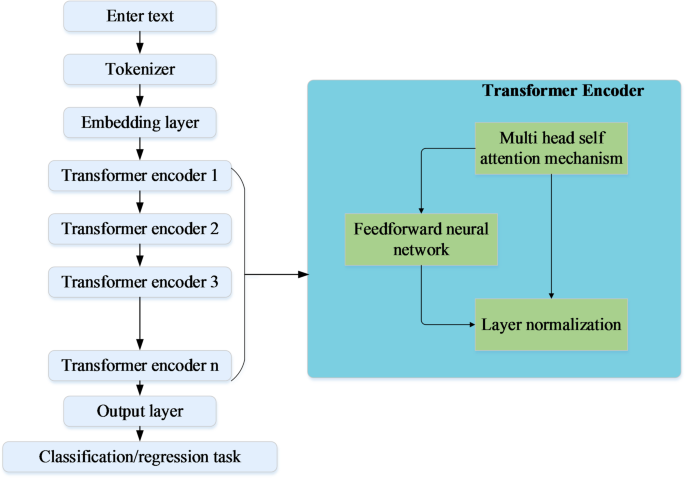
BERT is a pre-training model based on Transformer architecture, which has the advantage of two-way context understanding and can effectively capture grammatical and semantic information in long texts. Compared with traditional emotional analysis methods, BERT can not only understand the meaning of words, but also accurately judge the emotional tendency of words according to the context23,24. Therefore, BERT’s performance in emotional analysis tasks is often superior to other traditional models. Figure 1 shows the BERT structure.
BERT structure.
Figure 1 illustrates the architecture of the BERT model, a pre-trained language model based on the Transformer framework. Its main components include text input, a Tokenizer, an Embedding Layer, and multiple Transformer Encoder layers. In the figure, text is first processed by the tokenizer to convert it into a format suitable for model input. The embedding layer then transforms the text into vector representations, which are fed into multiple Transformer encoder layers for processing. Each Transformer encoder contains a Multi-head Self-Attention Mechanism and a Feedforward Neural Network, and undergoes Layer Normalization to ensure training stability. Finally, after processing by multiple Transformer encoder layers, the output layer uses the model’s representations for classification or regression tasks. This architecture enables BERT to effectively capture contextual information in text, thereby enhancing the performance of tasks such as sentiment analysis and text classification.
In order to analyze emotion, students’ writing texts or classroom interaction data need to be labeled first, and the categories of labeling include positive, negative and neutral emotional labels. Based on these labeled data, BERT is used for pre-training and fine-tuning. In the pre-training stage, BERT model learns the basic structure of language. In the fine-tuning stage, the marked data is input into the model, and the model is classified and learned according to the emotional tags25. Equation 1 shows the input format of pre-trained BERT:
In Eq. 1, (left[ {CLS} right]) is a classification mark, indicating the beginning of the input sequence, and (left[ {SEP} right]) is a separator, indicating the end of the sentence. In text sentiment analysis, students’ writing texts are input into BERT model, and BERT captures context information through Self-Attention mechanism to generate hidden representation vectors of each word or sentence. Finally, the hidden representation is mapped to the probability distribution of emotion categories through a Feed-forward layer, and the emotion classification results of the text are obtained26,27. Equation 2 shows the output of BERT model:
(W) is the weight matrix. (h) is the hidden vector extracted from the BERT model, (b) is the bias term, and (Softmax) is the activation function, which is used to convert the output into the category probability28.
In addition to using BERT model to deeply analyze the emotional tendency of students’ texts, this study also aims to explore the theme structure and semantic depth of their writing content. To this end, Latent Dirichlet Allocation (LDA) model is a topic modeling method based on probability generation model, which assumes that each document consists of multiple topics, and each topic consists of multiple words. The goal of LDA is to find the theme structure in a large number of documents through the analysis29,30. Equation 3 shows the generation process of LDA model:
In Eq. 3, (w_{n}) represents the (n)th word in the document. (z_{n}) represents the theme corresponding to the word. θ represents the theme distribution of the document. (phi_{k}) represents the word distribution of each theme. (K) is the number of themes, and (N) is the number of words in the document31.
LDA model provides a macro perspective of topic distribution, but to deeply understand students’ language expression accuracy and concept relevance under specific topics, micro-level semantic analysis is needed. Semantic Analysis refers to understanding the deep meaning and semantic structure in a text through a computer model. In English language teaching, semantic analysis not only pays attention to the superficial meaning of words, but also pays attention to the actual meaning of words in a specific context. Word2Vec is an ideal tool to achieve this goal. Word2Vec is a model that learns the vector representation of words through neural network. It can effectively capture the semantic relationship between words by mapping words to vector representation in low-dimensional space32. Word vectors trained by Word2Vec can be used to calculate the similarity between words. For example, given two words “student” and “learning”, Word2Vec model can calculate their word vectors and measure their closeness in semantic space by calculating cosine similarity33. Equation 4 shows the cosine similarity calculation:
(A) and (B) are two word vectors respectively. (A) and (B) are their module lengths.
Based on the complementarity of LDA and Word2Vec in analysis level (document level vs vocabulary level) and function (topic recognition vs semantic relevance), this study combines them to realize multi-dimensional analysis of students’ language performance. This integration strategy (as shown in Fig. 2) can reveal both the macro theme structure and the micro semantic precision of students’ writing. LDA can help identify the theme structure in students’ writing, while Word2Vec can provide more fine-grained semantic information. Combining these two technologies, students’ writing ability and language mastery can be analyzed from multiple levels34. Figure 2 shows the process of topic modeling and semantic analysis based on LDA and Word2Vec.
Topic modeling and semantic analysis process based on LDA and Word2Vec.
Figure 2 illustrates the workflow of topic modeling and semantic analysis based on LDA and Word2Vec. First, input text data goes through a preprocessing stage, including steps like stop word removal and word segmentation. Next, the Word2Vec model is employed to train word vectors, learning the word embedding representation of each word and generating a word vector model. In this process, Word2Vec captures the relationships between words in the text to produce word vectors that facilitate semantic understanding. Concurrently, LDA topic modeling is applied to identify the latent topic distributions within the text. The LDA model first initializes topics and gradually refines them by estimating topic distributions and updating word distributions until the final topic distributions are obtained. During semantic analysis, the integration of Word2Vec and LDA models enables comprehensive mining of both topic and semantic information in the text, supporting subsequent topic labeling and classification tasks. Finally, the system assigns topic labels to each text based on the semantic analysis results and topic model outputs. This workflow effectively analyzes latent topics and deep semantics in texts, providing robust data support for teaching evaluations.
The optimization of deep learning model is the core step to improve its performance. The purpose of optimization is to improve the convergence speed of the model, avoid over-fitting and ensure its good performance on real data. Optimization algorithm plays an important role in training deep neural network. Adaptive Moment Estimation (Adam optimizer) is one of the most widely used optimization algorithms at present. It combines the advantages of RMSprop and momentum method, and can automatically adjust the learning rate of each parameter in the training process, thus accelerating the convergence process of the model and reducing the training error35,36. Equation 5 to Eq. 9 show the update of Adam optimization algorithm:
(g_{t}) represents the current gradient. (m_{t}) and (v_{t}) represent the first moment and the second moment of the gradient respectively. (eta) is the learning rate. (beta_{1}) and (beta_{2}) are hyperparameters. (epsilon) is a small constant to avoid the divide-by-zero error.
Although the above BERT, LDA and Word2Vec models have performed well in their respective tasks, the robustness and generalization ability of a single model are still facing challenges when dealing with multi-dimensional, complex and possibly noisy English teaching evaluation data. To further improve the overall accuracy and stability of the evaluation system and reduce the risk of over-fitting, an ensemble learning method is introduced in this study. The core idea of ensemble learning is to combine multiple base learners together and obtain better performance through the prediction results of multiple models. Its advantage is that it can make up for the limitations of a single model through the cooperative work of multiple models, reduce the risk of over-fitting of the model and improve the accuracy of prediction. Specifically, this study explores three integration strategies: Bagging, XGBoost and Stacking, and incorporates the deep learning model (such as BERT, LSTM) introduced in “Intelligent Text Analysis” Section into the integration framework as an important basic learner. Long Short-Term Memory (LSTM) can effectively capture long-distance dependency relationships due to its gating mechanisms (forget gate, input gate, output gate), especially demonstrating excellent performance in processing complex sequential semantic information in students’ writing and oral expressions. In contrast, although Gated Recurrent Unit (GRU) has a simpler structure, its modeling capability for long sequences is slightly inferior to that of LSTM. Additionally, the Stacking integration method introduces a meta-learner (such as linear regression) to fuse the outputs of multiple models, fully leveraging the advantages of different models (e.g., BERT’s semantic understanding, LSTM’s sequential modeling, XGBoost’s efficient classification), thereby enhancing the model’s generalization ability. By comparison, Bagging and Boosting mainly focus on homogeneous models and struggle to handle the collaborative optimization of heterogeneous models.
Bagging is the most basic method in ensemble learning. Its basic idea is to generate a number of different data subsets by random sampling with replacement of the original dataset, and to train a number of basic learners based on these subsets. The final prediction result is the average value (regression task) or the voting result (classification task) output by the base learner. Bagging method can effectively reduce the variance of the model, improve the stability of the model and reduce the possibility of over-fitting. The core steps of Bagging method are shown in Fig. 3.
The core steps of Bagging method.
Figure 3 illustrates the four-step process of the Bagging method: Bootstrap sampling, base learner training, prediction result integration, and final output. The Bagging method generates multiple Bootstrap subsets (B1, B2, …, Bn) from the original dataset (D), trains base learners (such as decision trees) for each subset, and finally integrates the prediction results of all models (through voting or averaging) to produce the final output.
Extreme Gradient Boosting (XGBoost) is an ensemble learning algorithm based on Gradient Boosting Decision Trees (GBDT). It learns residuals through multiple iterations and learns a new decision tree in each iteration. XGBoost reduces over-fitting through regularization, and adopts an efficient splitting algorithm, which can effectively handle large-scale data. The core optimization objective of XGBoost model is to minimize the following objective function, as shown in Eq. 10:
({mathcal{L}}left( {y_{i} ,hat{y}_{i} } right)) is the loss function. ({Omega }left( {f_{k} } right)) is the regularization term of the complexity of the base learner. (f_{k}) represents the structure of the k-th tree. (y_{i}) is the real label of the i-th sample. (hat{y}_{i}) is the predicted value of the i-th sample.
Stacking is an integration method based on multi-level model. It trains several different basic learners and inputs their outputs as new features into a Meta-Learner for final prediction. The key of Stacking method lies in how to choose a suitable basic learner and how to train a suitable meta-learner. Different from Bagging and Boosting, Stacking not only relies on multiple basic learners of the same type, but enriches the feature space by using multiple types of learners, thus improving the generalization ability of the model. The core steps of Stacking are shown in Table 1.
This study evaluates the effect of English language teaching, and collects student data from multiple dimensions, including students’ personal information, academic performance, emotional analysis, learning progress, teaching interaction and other information. Data are collected mainly in two ways: First, teachers manually record students’ grades, homework feedback and classroom interaction in class. Second, the online learning platform is used to automatically collect students’ homework submission, online test scores and emotional analysis results.
The dataset used in this study is independently collected by the research team. The dataset has undergone strict anonymization processing to ensure that it does not contain any personal identification information of students (such as name, student ID, contact information). During the data collection process, all student participants joined the study voluntarily and signed informed consent forms. To protect privacy, student identity information was replaced with randomly generated unique identifiers (UIDs) at the data entry stage. Text data (such as writing assignments and oral transcriptions) was manually reviewed to remove content that might reveal personal identities (such as descriptions of specific events and home addresses). Original audio files are deleted after classroom recordings and text data were transcribed, and only anonymized text was retained. The research process does not involve any inductive or sensitive questions to ensure that the legitimate rights and interests of participants were not infringed.
The main fields of data collection are shown in Table 2:
Text data preprocessing includes the following steps: (1) Tokenization: Standardized tokenization of students’ written and transcribed oral texts using the spaCy English tokenizer. (2) Noise Removal: Elimination of punctuation, stopwords (from the NLTK English stopword list), and non-English characters. (3) Handling Multilingual Content: Identification and filtering of non-English paragraphs using the LangDetect library. (4) Data Balancing: Addressing the imbalance in sentiment labels (e.g., disproportionately high neutral samples) through SMOTE algorithm oversampling of minority classes to achieve an approximate 1:1:1 ratio among the three sentiment categories. (5) Text Standardization: Conversion to lowercase and application of lemmatization to restore word forms. These steps ensure the dataset is clean, linguistically consistent, and balanced for effective model training.
The experimental environment of this study is equipped with efficient hardware and software to ensure the smooth training of deep learning model and data processing. The experimental environment is shown in Table 3.
In the process of model training and data analysis, the selection of hyperparameters has an important influence on the performance of the model. All model hyperparameters were determined via grid search combined with fivefold cross-validation. Take XGBoost as an example, the search scope covered learning rate (0.01–0.2), maximum tree depth (3–10), and regularization term λ (0.1–1.0). The parameter combination with the minimum validation set loss was finally selected: learning rate 0.05, maximum depth 6, and λ = 0.5. For the BERT model, a layer-wise unfreezing strategy is adopted during training: only the top layers were fine-tuned in the first two rounds, and all layers are unfrozen in the third round to balance training efficiency and model performance. Additionally, the meta-learner (logistic regression) in Stacking used L2 regularization (C = 1.0) to avoid overfitting. Table 4 shows the main model parameter settings.
Figure 4 shows the performance evaluation results of different models. It shows that the ensemble learning method (especially the Stacking model) shows more obvious advantages than the single model. In the performance of training set, the accuracy of Stacking model reaches 95.0%, which is significantly higher than other single models, such as BERT (93.2%), LSTM (89.7%), random forest (86.3%) and XGBoost (94.5%). Moreover, the performance of the Stacking model in precision, recall and F1 value is 94.8%, 95.1% and 94.9% respectively, which are superior to other models, especially in recall and F1 value. Stacking model makes up for the limitations of a single model in a specific task and improves the stability and accuracy of the overall evaluation by weighted fusion of the prediction results of several basic models (such as BERT, LSTM, XGBoost, etc.). In the test set results, the performance of Stacking model is still better than other single models. Its accuracy rate is 94.3%. Although it is slightly lower than the training set, it is still significantly higher than BERT (91.9%) and LSTM (87.9%), and also higher than XGBoost (93.1%) and random forest (83.4%). In addition, the Stacking model also maintains a high level in precision, recall and F1, which are 94.0%, 94.5% and 94.2% respectively, which further proves the advantages of the ensemble learning method. It is worth noting that although the BERT model performs well on the training set, its accuracy on the test set drops slightly, which shows that the adaptability of the model on new data is not as good as that of the Stacking model. However, the performance of LSTM and random forest is relatively weak, especially the LSTM model, whose accuracy on the test set is only 87.9%, which is far from other models.
The performance evaluation results of different models ((a) training set; (b) test set).
Figure 4 shows the significant advantages of integrated model (especially Stacking) in comprehensive evaluation indicators. To investigate the performance of the model in the key subtask-emotion analysis, Fig. 5 shows the emotional analysis results of the model optimized by BERT, LSTM and CNN. It shows that the accuracy, precision, recall and F1 value of the optimized fusion model of BERT, LSTM, CNN and self-attention mechanism are greatly improved in emotional analysis tasks, which proves the powerful ability of multimodal fusion model in handling emotional analysis tasks.
BERT and LSTM combine the self-attention mechanism with the emotional analysis results of CNN optimized model.
In addition to emotional analysis, the analysis of the theme structure and semantic depth of students’ writing content is another core dimension of teaching effect evaluation. Figure 6 shows the performance of LDA + Word2Vec in teaching content analysis. It shows that the combination model of LDA and Word2Vec is particularly prominent in the analysis of teaching content. By combining LDA for topic modeling and Word2Vec for lexical semantic analysis, the accuracy of the model reaches 90.1%, which is significantly improved compared with LDA (86.5%) and Word2Vec (88.3%) alone. This shows that the model has a strong ability to evaluate students’ understanding and mastery of different teaching contents by extracting the topics of students’ concern through LDA and combining with the in-depth analysis of semantic relations between words by Word2Vec.
Performance of LDA + Word2Vec in teaching content analysis.
The improvement of the above-mentioned emotional analysis and teaching content analysis ability will ultimately serve the comprehensive evaluation of English teaching effect. Figure 7 shows the evaluation results of English language teaching effect based on the optimization model of BERT, LSTM and CNN combined with self-attention mechanism. It shows that the optimization model based on the self-attention mechanism of BERT, LSTM and CNN is obviously superior to the traditional model and other deep learning models in all dimensions. Especially in the comprehensive evaluation, the accuracy rate of the optimized model is 92.3%. It is nearly 8% points higher than that of the traditional LDA+ Support Vector Machine (SVM) model (83.8%), showing the remarkable advantages of the deep learning optimization scheme in the evaluation of English language teaching effect.
Evaluation results of English language teaching effect based on the optimization model of BERT, LSTM and CNN combined with self-attention mechanism.
To more clearly highlight the progress of the fusion model proposed in this study in the task of emotional analysis, Fig. 8 shows the performance of fusion model and traditional model in students’ emotional analysis. Through the direct comparison with the representative traditional model, it shows that the accuracy of sentiment analysis of the fusion model is obviously better than that of the traditional model. By introducing BERT, LSTM, CNN and self-attention mechanism, the accuracy of emotional analysis has been improved from the traditional 78.4 to 91.7%, which shows that the model is extremely accurate in the classification of emotional tendencies. This provides a powerful tool for teachers and researchers to accurately understand the emotional state of students in the learning process.
Performance of fusion model and traditional model in students’ emotional analysis.
The results of Fig. 8 directly show the performance differences of each model. To quantitatively verify whether these differences (especially the advantages of Stacking model over other models) are statistically significant, and to confirm the statistical significance of the differences between the Stacking model and other models (such as XGBoost and BERT), this study uses the paired t-test to compare the accuracy of the training set and test set, and calculated the 95% confidence interval (CI). All experiments are based on 5 repeated runs with random seeds to obtain the mean value. The results show that the accuracy difference between the Stacking model and XGBoost on the test set is 1.2% (p = 0.003, CI [0.8%, 1.6%]), and the difference from BERT is 2.4% (p < 0.001, CI [1.9%, 2.9%]), indicating that the performance improvement was statistically significant (significance level α = 0.05). The statistical test results show that the performance improvement of the Stacking model compared with other models reach a significant level (p < 0.05). The confidence interval does not include zero, further supporting the superiority of the integration method. Although the difference between LSTM and random forest is significant, its absolute value is low, reflecting the limitations of single models in complex tasks. The comparison results between LSTM and random forest are shown in Table 5.
In addition to statistical significance, the practicability of the model in the actual teaching scene is very important, and its evaluation results need to be comparable to the judgments of senior teachers. Therefore, to verify the model’s practicality, this study collects teacher evaluation data (N = 200) from the same group of students, where three senior English teachers independently score assignments using a 5-point scale, focusing on writing logic, grammatical accuracy, and emotional expression. By aligning teacher scores with model predictions (discretized into high, medium, low tiers), the study calculates consistency (Cohen’s Kappa coefficient) and accuracy between model outputs and teacher evaluations. Results show that the Stacking model outperformed traditional teacher assessments in both accuracy and consistency. Notably, inter-rater reliability among teachers is relatively low (Kappa = 0.71), highlighting the subjectivity of manual evaluations. The model’s high Kappa value (0.82) indicates its effectiveness in replacing or supplementing human assessments to enhance objectivity. Specific comparisons are presented in Table 6.
To further verify the model’s novelty, this study compared it with representative models in the field of educational AI, including the Multimodal Fusion Model (MFM) proposed by Liu et al.37 and the LSTM-CNN self-attention model by Hu et al.38. Experimental results show that the Stacking model achieved a significantly higher accuracy (94.3%) on the same test set than MFM (92.1%) and LSTM–CNN (89.5%), with F1-scores improved by approximately 3.8% and 5.2%, respectively. Compared with existing studies, the model in this paper demonstrates significant advantages in all indicators, especially in recall (94.5%) and F1-score (94.2%), reflecting the effectiveness of the multi-model integration and optimization strategy. The performance comparison between the proposed model and educational AI benchmark models is shown in Table 7.
To verify the model’s generalization ability, this study adds student data (N = 600) from three universities in Malaysia, Singapore, and China, covering different English proficiency levels and cultural backgrounds. Stratified Cross-Validation is adopted to divide the training set and test set by school. The results show that the Stacking model achieves an average accuracy of 93.2% with a standard deviation of 1.5% in cross-institutional tests, significantly higher than single models (e.g., BERT’s cross-institutional accuracy is 89.7% ± 2.1%). Although the accuracy on the PKU dataset is slightly higher (93.3%), possibly related to the distribution of students’ English proficiency, the overall performance is stable. The specific results are shown in Table 8.
Based on the above experimental results (including the overall performance of the model, the performance of key subtasks, statistical significance verification, teacher evaluation and comparison, and cross-institutional generalization ability test), in this study, the ensemble learning method and deep learning optimization technology have significantly improved the accuracy and stability of English language teaching effect evaluation. Especially when Stacking model is used for multi-dimensional data fusion, it shows more obvious advantages than single model (such as BERT, LSTM, XGBoost, etc.). It is consistent with the research results of Liu et al.37. Liu et al.37 used ensemble learning method in their research, and found that the accuracy of sentiment analysis and text classification tasks can be effectively improved by fusing the results of multiple basic models. However, by optimizing the model design (such as BERT combined with self-attention mechanism and CNN), this study further improves the performance of Stacking model in the evaluation of English language teaching effect, making its accuracy in training set and test set reach 95.0% and 94.3% respectively, far exceeding the traditional model and single deep learning model. Compared with the emotion analysis model proposed by Hu et al.38 based on the self-attention mechanism of LSTM and CNN, the optimized model not only improves the accuracy of emotion analysis (91.7%), but also improves the comprehensive performance of the model by fusing multimodal information. In addition, the combined use of LDA and Word2Vec in this study improves the accuracy of teaching content analysis, which is similar to the research of who extracted teaching topics through LDA and analyzed lexical semantics with Word2Vec, and achieved good results. However, the research of Qi et al.39 mainly focused on single topic modeling and vocabulary analysis. While this study significantly improves the accuracy in the evaluation of teaching content through more detailed model optimization and multimodal data fusion, especially in the evaluation of students’ mastery of different teaching content.
The main contribution of this study is to propose an evaluation method of English language teaching effect based on ensemble learning and deep learning optimization technology. Firstly, by combining Stacking ensemble learning model with deep learning model (such as BERT, LSTM, CNN), this study significantly improves the accuracy and stability of the evaluation model, especially in multi-dimensional data fusion and sentiment analysis tasks. Secondly, this study innovatively combines the self-attention mechanism and CNN optimization technology with the traditional deep learning model, which improves the accuracy and semantic understanding ability of emotional analysis and provides a more accurate tool for educational data analysis. In addition, through the combination of LDA and Word2Vec, this study has made a great breakthrough in the analysis of teaching content and successfully improved the model performance in the evaluation of teaching effect.
Although the proposed integrated model demonstrates high accuracy in English teaching effectiveness assessment, it still has the following limitations: First, the data samples mainly come from students of Malaysian universities (University of Malaya), whose English learning backgrounds and cultural environments are relatively homogeneous (e.g., most students are non-native English speakers in Southeast Asia), which may lead to insufficient adaptability of the model to students in other regions (such as Europe, America, or Africa). Preliminary cross-institutional experiments show that the model’s accuracy in data from Asian universities is significantly higher than that of European and American samples, which is speculated to be related to differences in language acquisition patterns. Second, model training relies on high-performance computing resources, which may face hardware adaptation challenges when promoted in primary and secondary schools or underdeveloped areas with limited resources. In addition, incremental learning of dynamic data in real-time teaching scenarios has not been realized. The current model still mainly relies on offline batch training, making it difficult to support low-latency instant classroom feedback. Future work will focus on expanding data diversity (such as including low-resource language students in multilingual mixed scenarios), and exploring lightweight model architectures (such as knowledge distillation technology to compress BERT parameters) and edge computing deployment solutions to improve the model’s universality and practicality.
The datasets used and/or analyzed during the current study are available from the corresponding author Ye Zhang on reasonable request via e-mail s2150446@siswa.um.edu.my.
Schmidt, T. & Strasser, T. Artificial intelligence in foreign language learning and teaching: a CALL for intelligent practice. Angl.: Int. J. Engl. Stud. 33, 165–184 (2022).
Article Google Scholar
Liu, L. & Tsai, S. B. Intelligent recognition and teaching of English fuzzy texts based on fuzzy computing and big data. Wirel. Commun. Mob. Comput. 2021, 1170622 (2021).
Article Google Scholar
Taherdoost, H. & Madanchian, M. Artificial intelligence and sentiment analysis: A review in competitive research. Computers 12, 37 (2023).
Article Google Scholar
Liang, J. C. et al. Roles and research foci of artificial intelligence in language education: An integrated bibliographic analysis and systematic review approach. Interact. Learn. Environ. 31, 4270–4296 (2023).
Article Google Scholar
Gayam, S. R. Artificial intelligence for natural language processing: techniques for sentiment analysis, language translation, and conversational agents. J. Artif. Intell. Res. Appl. 1, 175–216 (2021).
Google Scholar
Chen, Y. Analyzing the design of intelligent English translation and teaching model in colleges using data mining. Soft. Comput. 27, 14497–14513 (2023).
Article Google Scholar
Liu, W., Zhang, Y. & Wang, T. Research on students’ satisfaction of intelligent learning based on text mining technology. Comput. Intell. Neurosci. 2022, 4024263 (2022).
PubMed PubMed Central Google Scholar
Chen, X. et al. Two decades of artificial intelligence in education. Educ. Technol. Soc. 25, 28–47 (2022).
Google Scholar
Lin, S. Y., Kung, Y. C. & Leu, F. Y. Predictive intelligence in harmful news identification by BERT-based ensemble learning model with text sentiment analysis. Inf. Process. Manage. 59, 102872 (2022).
Article Google Scholar
Babu, N. V. & Kanaga, E. G. M. Sentiment analysis in social media data for depression detection using artificial intelligence: A review. SN Comput. Sci. 3, 74 (2022).
Article PubMed Google Scholar
Trappey, A. J. C. et al. Intelligent RFQ summarization using natural language processing, text mining, and machine learning techniques. J. Glob. Inf. Manag. 30, 1–26 (2022).
Article Google Scholar
Verma, S. Sentiment analysis of public services for smart society: Literature review and future research directions. Gov. Inf. Q. 39, 101708 (2022).
Article Google Scholar
Ahn, J., Nguyen, H. & Campos, F. From visible to understandable: Designing for teacher agency in education data visualizations. Contemp. Issues Technol. Teach. Educ. 21, 155–186 (2021).
Google Scholar
Wang, Y. Emotion and syntactic complexity in L2 writing: A corpus-based study on Chinese college-level students’ English writing. Asian J. Appl. Linguist. 7, 1–17 (2020).
Google Scholar
Kandhro, I. A. et al. Sentiment analysis of students’ comment using long-short term model. Indian J. Sci. Technol. 12, 1–16 (2019).
Google Scholar
Charoenkwan, P. et al. BERT4Bitter: A bidirectional encoder representations from transformers (BERT)-based model for improving the prediction of bitter peptides. Bioinformatics 37, 2556–2562 (2021).
Article CAS PubMed Google Scholar
Gaftandzhieva, S. et al. Exploring online activities to predict the final grade of student. Mathematics 10, 3758 (2022).
Article Google Scholar
Jayaraman, P. et al. Critical review on water quality analysis using IoT and machine learning models. Int. J. Inf. Manag. Data Insights 4, 100210 (2024).
Google Scholar
Wan, T. & Chen, Z. Exploring generative AI assisted feedback writing for students’ written responses to a physics conceptual question with prompt engineering and few-shot learning. Phys. Rev. Phys. Educ. Res. 20, 010152 (2024).
Article Google Scholar
Zhang, Z. Q. et al. Cross-lingual self-training to learn multilingual representation for low-resource speech recognition. Circuits Syst. Sign. Process. 41, 6827–6843 (2022).
Article Google Scholar
Nguyen, L., Yuan, Z. & Seed, G. Building educational technologies for code-switching: Current practices, difficulties and future directions. Languages 7, 220 (2022).
Article Google Scholar
Solovyev, V., Solnyshkina, M. & Tutubalina, E. Topic modeling for text structure assessment: The case of Russian academic texts. J. Lang. Educ. 9, 143–158 (2023).
Article Google Scholar
Nadeem, A. et al. Depression detection based on hybrid deep learning SSCL framework using self-attention mechanism: An application to social networking data. Sensors 22, 9775 (2022).
Article PubMed PubMed Central Google Scholar
Bhuvaneshwari, P. et al. Sentiment analysis for user reviews using Bi-LSTM self-attention based CNN model. Multimed. Tools Appl. 81, 12405–12419 (2022).
Article Google Scholar
Huang, F. et al. Attention-emotion-enhanced convolutional LSTM for sentiment analysis. IEEE Trans. Neural Netw. Learn. Syst. 33, 4332–4345 (2021).
Article Google Scholar
Peng, H., Zhang, Z. & Liu, H. A sentiment analysis method for teaching evaluation texts using attention mechanism combined with CNN-BLSTM model. Sci. Program. 2022, 8496151 (2022).
Google Scholar
Huang, Z. et al. A model for EEG-based emotion recognition: CNN-BI-LSTM with attention mechanism. Electronics 12, 3188 (2023).
Article Google Scholar
Wang, S. et al. Emotion-semantic-enhanced bidirectional LSTM with multi-head attention mechanism for microblog sentiment analysis. Information 11, 280 (2020).
Article Google Scholar
Chen, S. et al. The impact of attention mechanisms on speech emotion recognition. Sensors 21, 7530 (2021).
Article PubMed PubMed Central Google Scholar
Tao, W. et al. EEG-based emotion recognition via channel-wise attention and self attention. IEEE Trans. Affect. Comput. 14, 382–393 (2020).
Article Google Scholar
Li, X. et al. Research on EEG emotion recognition based on CNN+ BiLSTM+ self-attention model. Optoelectron. Lett. 19, 506–512 (2023).
Article Google Scholar
Maji, B. & Swain, M. Advanced fusion-based speech emotion recognition system using a dual-attention mechanism with conv-caps and bi-GRU features. Electronics 11, 1328 (2022).
Article Google Scholar
Feng, L. et al. EEG-based emotion recognition using spatial-temporal graph convolutional LSTM with attention mechanism. IEEE J. Biomed. Health Inform. 26, 5406–5417 (2022).
Article PubMed Google Scholar
Kardakis, S. et al. Examining attention mechanisms in deep learning models for sentiment analysis. Appl. Sci. 11, 3883 (2021).
Article CAS Google Scholar
Zhang, P. et al. Psychological stress detection according to ECG using a deep learning model with attention mechanism. Appl. Sci. 11, 2848 (2021).
Article CAS Google Scholar
Kim, H. G., Jeong, D. K. & Kim, J. Y. Emotional stress recognition using electroencephalogram signals based on a three-dimensional convolutional gated self-attention deep neural network. Appl. Sci. 12, 11162 (2022).
Article CAS Google Scholar
Liu, X. et al. Emotion classification for short texts: An improved multi-label method. Human. Soc. Sci. Commun. 10, 1–9 (2023).
CAS Google Scholar
Hu, Z. et al. EEG-based emotion recognition using convolutional recurrent neural network with multi-head self-attention. Appl. Sci. 12, 11255 (2022).
Article CAS Google Scholar
Qi, Y. & He, J. Application of LDA and word2vec to detect English off-topic composition. PLoS ONE 17, e0264552 (2022).
Article CAS PubMed PubMed Central Google Scholar
Download references
This research received no external funding.
Faculty of Education, Universiti Malaya, 50603, Kuala Lumpur, Kuala Lumpur, Malaysia
Zihe Wu & Ye Zhang
PubMed Google Scholar
PubMed Google Scholar
Zihe Wu: Conceptualization, methodology, software, validation, formal analysis, investigation, resources, data curation, writing—original draft preparation. Ye Zhang: writing—review and editing, visualization, supervision, project administration, funding acquisition.
Correspondence to Ye Zhang.
The authors declare no competing interests.
The studies involving human participants were reviewed and approved by Faculty of Education, Universiti Malaya Ethics Committee (Approval Number: 2023.494950009). The participants whose age was below 16 provided a parent and/or legal guardian’s written informed consent for study participation. All methods were performed in accordance with relevant guidelines and regulations. The participants whose age was above 16 provided a written informed consent for study participation.
Springer Nature remains neutral with regard to jurisdictional claims in published maps and institutional affiliations.
Open Access This article is licensed under a Creative Commons Attribution-NonCommercial-NoDerivatives 4.0 International License, which permits any non-commercial use, sharing, distribution and reproduction in any medium or format, as long as you give appropriate credit to the original author(s) and the source, provide a link to the Creative Commons licence, and indicate if you modified the licensed material. You do not have permission under this licence to share adapted material derived from this article or parts of it. The images or other third party material in this article are included in the article’s Creative Commons licence, unless indicated otherwise in a credit line to the material. If material is not included in the article’s Creative Commons licence and your intended use is not permitted by statutory regulation or exceeds the permitted use, you will need to obtain permission directly from the copyright holder. To view a copy of this licence, visit http://creativecommons.org/licenses/by-nc-nd/4.0/.
Reprints and permissions
Wu, Z., Zhang, Y. The data visualization and intelligent text analysis for effective evaluation of English language teaching. Sci Rep 15, 22737 (2025). https://doi.org/10.1038/s41598-025-08182-0
Download citation
Received:
Accepted:
Published:
DOI: https://doi.org/10.1038/s41598-025-08182-0
Anyone you share the following link with will be able to read this content:
Sorry, a shareable link is not currently available for this article.
Provided by the Springer Nature SharedIt content-sharing initiative
Advertisement
Scientific Reports (Sci Rep)
ISSN 2045-2322 (online)
© 2025 Springer Nature Limited
Sign up for the Nature Briefing: AI and Robotics newsletter — what matters in AI and robotics research, free to your inbox weekly.