

New ITER Boutique! Purchase ITER-branded merchandise here.
Your email address will only be used for the purpose of sending you the ITER Organization publication(s) that you have requested. ITER Organization will not transfer your email address or other personal data to any other party or use it for commercial purposes.
If you change your mind, you can easily unsubscribe by clicking the unsubscribe option at the bottom of an email you’ve received from ITER Organization.
For more information, see our Privacy policy.
Select your newsletters:
ITER Newsline
Keep in touch with ITER through our main news feed, sent weekly.
ITER Magazine – French only
Learn more about the ITER Project by subscribing to this quarterly online magazine (in French) that is geared toward the general public.
ITER Open Doors Day – Notifications
Stay informed about the ITER Open Doors sessions and be among the first to subscribe to the next event.
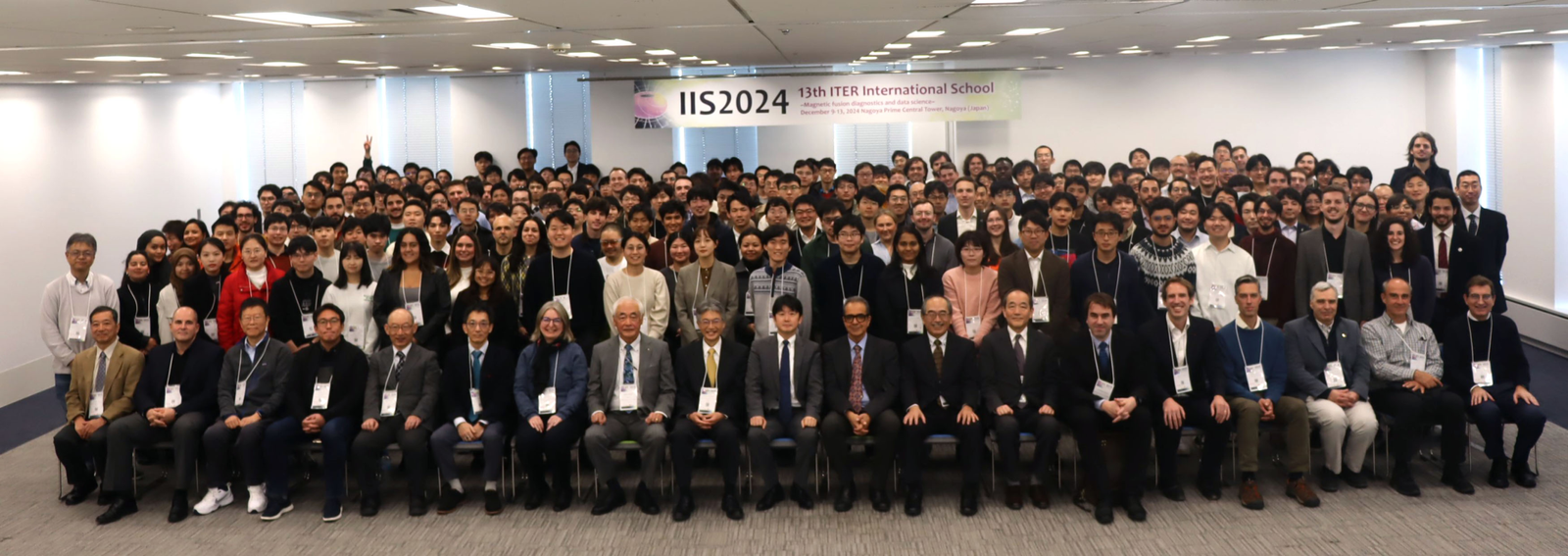
The 13th ITER International School concluded successfully in Nagoya, Japan, on 13 December after five days of lectures and discussions. Nearly 200 people from 21 countries participated.
The 2024 ITER International School on magnetic fusion diagnostics and data science was successfully held from 9 to 13 December. The event gathered 199 participants from 21 different countries, representing a diverse and international community of experts in the field. The lectures were delivered by 19 prominent specialists in diagnostics and data science for magnetic fusion devices.
The ITER International School was the 13th in the series, which alternates between sites within the ITER Member countries and Aix-en-Provence, France, close to where ITER is being constructed. This time the school took place in Nagoya, Japan, hosted by the National Institute for Fusion Science (NIFS). The venue was the Nagoya Prime Central Tower, which provided excellent logistical support and facilities and allowed the participants to also enjoy the vibrant atmosphere of Nagoya’s city centre. A notable contribution to the success of the school was made by the Ministry of Education, Culture, Sports, Science and Technology (MEXT), which provided financial support for the school, and NIFS, which played a crucial role in hosting the event.
This year’s school focused on magnetic fusion diagnostics and data science. Diagnostics are key to the achievement of ITER fusion power demonstration goals, and they require the application of a wide range of techniques. But diagnostics are not enough to ensure ITER’s success; only through the advanced analysis of the data they provide will it be possible to guide the experiments towards their fusion power goals. Lectures spanned a wide range of topics, from focused talks on the design and application of single diagnostic systems to discussions of advanced data-driven and physics-informed machine learning techniques. The emerging symbiotic relationship between fusion diagnostics and data science was a key theme during this year’s school. Exchanges between participants highlighted how the fields of fusion diagnostics and data science are increasingly reliant on one another—with fusion diagnostics providing the essential data to data science models, and data science assisting with diagnostic design, calibration, fusion data and fault detection.
Approximately 50 diagnostics will be installed on ITER, distributed in ports, on the vacuum vessel surface, and in the divertor. These diagnostics will measure more than 100 parameters necessary for control of the plasma and first wall processes in order to achieve the required goals and to gain the knowledge needed for future reactor designs. The diagnostics on ITER will be subject to new challenges unprecedented in today’s tokamaks. The diagnostics will operate in a nuclear environment, which requires the design to mitigate atomic transmutation, radiation damage, and thermo-electric effects, as well as to cope with nuclear heating. Since ITER is a nuclear facility, the design, manufacture and installation of diagnostic components is subject to safety and quality requirements, in particular for installation on nuclear confinement barriers such as the vacuum vessel, vacuum vessel feedthroughs and windows. The school discussed the key fusion plasma diagnostics and how these will be implemented in ITER as well as in current tokamaks.
The application of data science to problems in magnetic fusion shows great promise. This year’s school highlighted the increasingly important role of scientific machine learning within the magnetic fusion field. The data science lectures covered a wide range of topics with domain experts presenting talks ranging from machine learning fundamentals to data assimilation and integrated modelling. Impressing results from the TCV tokamak in Switzerland showed how advanced machine learning models are assisting plasma control systems in disturbance and disruption avoidance.
The school invited students to compete in three data science challenges. These challenges were constructed from real tokamak data recorded by the MAST tokamak in the UK and hosted on the Kaggle platform. The fair-mast dataset provided the students with valuable lesson in the value of truly findable, accessible, interoperable, and reusable (FAIR) fusion datasets. Students were invited to train machine learning models to predict plasma current from discrete magnetics data, plasma volume from frames extracted from a visible spectrum camera, and the structure of magnetic field lines from a diverse set of diagnostic data. Competition in all three challenges was intense with competitors frequently switching positions on the public leaderboards during the week as new machine modelling techniques were learned or data insights applied. While the competition stage of the three data science challenges is now closed, these challenges will remain accessible on the Kaggle website if you would like to have a go. We wish you the best of luck if you do!
A press conference was also held just before the opening of the school to explain the overall aim and organization of IIS2024 and to answer questions. A domestic television station introduced the ITER International School and ITER in its evening program. Two newspapers ran articles about the school. In addition, a live broadcast for the press conference, opening, and overview talks of ITER and NIFS was distributed on a Japanese video distribution site, attracting over 4,000 viewers. The school was well publicized in Japan; see some sample videos here, here and here.
The quality of the work presented during the two poster sessions held at this year’s school was very high. The school participants along with the scientific committee selected the following six participants to award their outstanding research work with the presentation of a large format photo book describing progress on ITER construction from 2013 to 2024:
The data science challenges closed on the penultimate night before the week ended, allowing the following list of winners for each of the three challenges to be announced at the closing ceremony. The winners were presented with real sections of super-conducting cable used to wind ITER’s toroidal field coils.
One of the highlights of the school was the visit to the National Institute for Fusion Science, allowing school participants to see cutting-edge facilities first-hand. Three tours were provided: one on the Large Helical Device (LHD) and the control room, another on virtual reality and supercomputers, and a third on plasma heating beam development and fusion reactor engineering facilities. LHD, one of the largest fusion devices in operation worldwide, is a superconducting stellarator device characterized by a heliotron magnetic field configuration that was originally developed in Japan.
Overall, the 13th ITER International School was a resounding success, bringing together a diverse group of participants from around the world to exchange knowledge, share experiences, and foster collaboration on diagnostics and data science for magnetic fusion devices. The support from Japan’s MEXT, NIFS, the ITER Organization, the US Burning Plasma Organization, the International Atomic Energy Agency, and Aix-Marseille University greatly contributed to the success of this event.
The slides of the lectures will be available later this week on this ITER webpage together with the information on past ITER International Schools.
*Article authored by IIS2024 scientific program coordinators Masayuki Yokoyama (NIFS), Kenji Tanaka (NIFS), Martin Kocan (ITER) and Simon Mcintosh (ITER); host country committee members Katsuji Ichiguchi (chair, NIFS), Kenichi Nagaoka (vice-chair, NIFS); local organizing committee chair Hiyori Uehara (NIFS); school director Sadruddin Benkadda (Aix-Marseille University/CNRS); and chair of the scientific committee Alberto Loarte (ITER).
ITER (“The Way” in Latin) is one of the most ambitious energy projects in the world today.
ITER is charting new territory in fusion research. Join us.
© 2025, ITER organization











Leave a Reply