

The independent source for health policy research, polling, and news.
The independent source for health policy research, polling, and news.
Jennifer Tolbert, Sammy Cervantes, Clea Bell, and Anthony Damico
Published:
The pandemic-era coverage policies, including the Medicaid continuous enrollment provision and the enhanced Marketplace subsidies, continued to impact health coverage in the U.S. in 2023. During the pandemic, the coverage expansions put in place by the Affordable Care Act (ACA), including Medicaid expansion and subsidized Marketplace coverage, served as a safety net for people who experienced economic and coverage disruptions. Gains in Medicaid and Marketplace coverage contributed to significant declines in the uninsured rate through 2022. Although states began the process of unwinding continuous enrollment in Medicaid in April 2023 and resumed disenrolling people from Medicaid, the full effect of Medicaid disenrollments were not felt in 2023. In addition, the enhanced Marketplace subsidies, which were extended through 2025, remained in place. Both these factors contributed to maintaining most of the coverage gains experienced during the pandemic period in 2023.
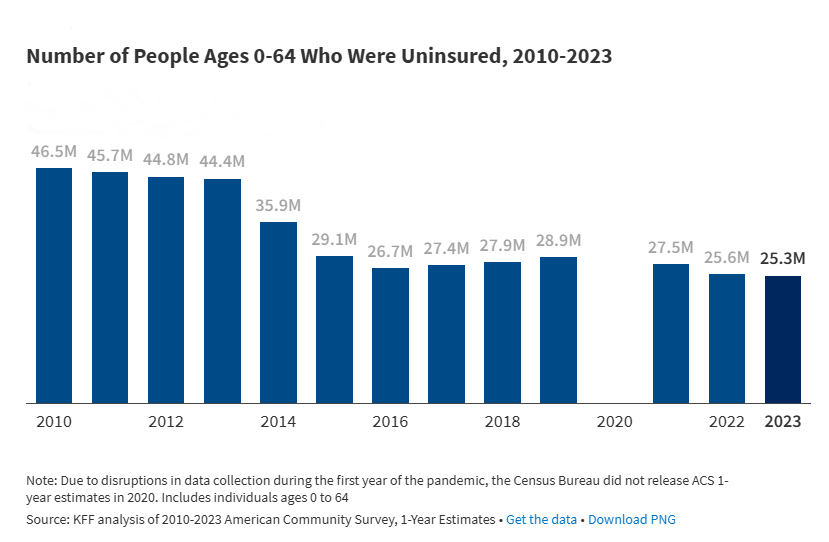
This issue brief describes trends in health coverage in 2023, examines the characteristics of the uninsured population ages 0-64, and summarizes the access and financial implications of not having coverage. Using data from the American Community Survey (ACS), this analysis examines changes in health coverage from 2022 to 2023 and compares data for 2023 to data for 2019 to report on coverage trends during the pandemic and through the start of the unwinding of the Medicaid continuous enrollment provision. Because of disruptions in data collection during the pandemic, the Census Bureau did not release 1-year ACS estimates in 2020. The analysis focuses on coverage among people ages 0-64 since Medicare offers near universal coverage for people ages 65 and older, with just 457,000, or less than 1%, of people over age 65 uninsured.
Although coverage rates for the overall population ages 0-64 held steady in 2023, future changes to Medicaid and Marketplace coverage could have a significant impact on health coverage. Proposals that would alter how Medicaid is financed or that would impose work requirements on certain adults enrolled in the program would likely lead to a loss of Medicaid coverage. Moreover, the temporary enhanced Marketplace subsidies will expire after 2025 unless Congress acts. Without a permanent extension, the Congressional Budget Office estimates that the number of uninsured people will increase by 3.8 million, on average, in each year from 2026 to 2034. The combined Medicaid and Marketplace coverage losses could lead to a sizable increase in the number of people who are uninsured. In turn, the loss of coverage could have implications for access to care and financial stability associated with having health coverage and could lead to a worsening of disparities in health outcomes.
Among the population ages 0-64, both the number of uninsured (25.3 million) and the uninsured rate (9.5%) remained at historic lows in 2023. A continued decline in the number of uninsured adults ages 19-64 was offset by an increase in the number of uninsured children. Compared to 2019, prior to the start of the pandemic, the number of uninsured and the uninsured rate for the population ages 0-64 were both significantly lower in 2023. Nearly all groups experienced coverage gains, but American Indian or Alaska Native (AIAN) and Hispanic people had larger gains than their White counterparts and low-income individuals and those in working families had bigger gains than those at higher incomes and those without a worker in the family.
Key Details:
Most of the 25.3 million people ages 0-64 who are uninsured are adults, in working low-income families, and are people of color. Reflecting geographic variation in income and the availability of public coverage, most uninsured people live in the South or West. In addition, most who are uninsured have been without coverage for long periods of time. (See Appendix Table B for detailed data on characteristics of the uninsured population.)
Lack of access to affordable health coverage is the main reason many people say they are uninsured. A majority of working age adults in the U.S. obtain health insurance through an employer; however, not all workers are offered employer-sponsored coverage or, if offered, can afford their share of the premiums. Medicaid covers many low-income individuals, especially children, but Medicaid eligibility for adults remains limited in most states that have not adopted the ACA expansion. Marketplace subsidies make coverage more affordable for many, but even subsidized Marketplace coverage can be unaffordable for some, and few people can afford to purchase private coverage without financial assistance.
Health insurance makes a difference in whether and when people get necessary medical care, where they get their care, and ultimately, how healthy they are. Uninsured adults are far more likely than those with insurance to postpone health care or forgo it altogether because of concerns over costs. The consequences can be severe, particularly when preventable conditions or chronic diseases go undetected.
Uninsured individuals often face unaffordable medical bills when they do seek care. These bills can quickly translate into medical debt since most people who are uninsured have low or moderate incomes and have little, if any, savings.
KFF Headquarters: 185 Berry St., Suite 2000, San Francisco, CA 94107 | Phone 650-854-9400
Washington Offices and Barbara Jordan Conference Center: 1330 G Street, NW, Washington, DC 20005 | Phone 202-347-5270
www.kff.org | Email Alerts: kff.org/email | facebook.com/KFF | twitter.com/kff
The independent source for health policy research, polling, and news, KFF is a nonprofit organization based in San Francisco, California.









Leave a Reply