

After a classmate is deported
How one student became a powerful voice for others with disabilities
Rural schools lose a lifeline to mental health support after Trump cut funding
Proactive campus policies, communication with students critical under ‘antagonistic’ federal actions, panel says
Head Start allies wait, worry about possible funding cuts
Pandemic-era push to ‘build solutions’ must continue, panel says
Play, potties, preschool: TK for All
California’s Reading Dilemma
Saving Head Start
Falling rates, rising risk: Vaccination rates down in California
Five Years Later: Covid’s Lasting Impact on Education
Getting Students Back to School
May 20, 2025
The future of California higher education under Trump
View Now
March 27, 2025
Five years after Covid: Innovations that are driving results
View Now
News Topics
Featured Special Reports
Federal Education Policy
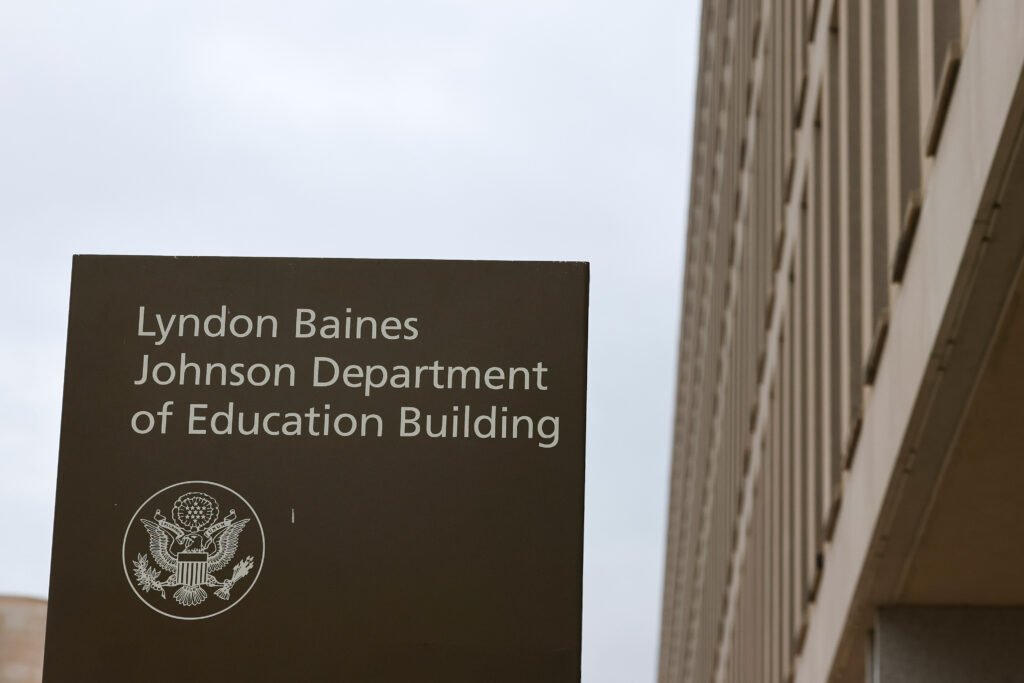
Several offices within the U.S. Department of Education have been gutted after reduction-in-force notices were sent to 466 staff on Friday, according to court filings, leaving education leaders uncertain about the potential fallout from losing hundreds of staff.
With the exception of top officials, such as directors, all staff were laid off from the department’s Office of Elementary and Secondary Education, which administers funding and technical assistance to programs, including the Individuals with Disabilities Education Act, known as IDEA, the McKinney-Vento Homeless Assistance Act, and the Migrant Education Program, among others. These programs primarily support children who make up some of the most vulnerable student groups, including those experiencing homelessness, migrant students and students with disabilities.
“The president talked about going after programs that Democrats support; they went after programs that everybody supports. By everyone, I mean the vast majority of those programs have strong bipartisan support,” said Barbara Duffield, executive director of SchoolHouse Connection, a national homeless advocacy organization.
Some of the staff who received reduction-in-force notices administer programs with federally mandated legal requirements, including IDEA and McKinney-Vento. Without the staff, it’s unclear how federal laws will be upheld.
“We are emphasizing the law is intact, the funding is intact, and we don’t know what’s gonna happen tomorrow, but those two things are true,” Duffield said.
Duffield and other advocates noted that many of the federal staff are experts, having often served in their positions for decades, and quickly answer questions based on their experience.
“All of the things that make these programs work for kids are built on the people behind them at the federal level, at the state level, and at the local level,” she added.
Without adequate staffing at the federal Department of Education, one of the more immediate concerns is that states and school districts may not get the appropriate support needed to address homeless students’ needs.
One of the key responsibilities of the education staff is to oversee the McKinney-Vento Homeless Assistance Act, a federal law implemented decades ago to ensure students experiencing homelessness are identified and properly supported. This law also requires homeless student counts, which is how the state knows that nearly 20,000 more homeless students were enrolled by the first Wednesday in October, known as Census Day, during the 2024-25 school year, representing a 9.3% change from the previous school year in California. This surge means the homeless student population in the state has increased 37% in the last decade.
The act outlines regulations mandated by federal law, such as ensuring that homeless students have “the same free, appropriate public education, including a public preschool education, as provided to other children and youths.” It also administers grants under the Education for Homeless Children and Youth program, commonly known as EHCY.
The federal Education Department is legally mandated to provide support to state education agencies, including:
During the aftermath of a natural disaster, school districts rely on the federal education staff for guidance on how to navigate such sudden changes, Duffield said, noting that homelessness rates among children tend to spike after environmental disasters, including wildfires.
“This is not about fewer federal workers. This is about: Does this law get implemented, and do the children and youth for whom it was designed to benefit, do they actually get the benefits?” Duffield said. “And in the case of students who are homeless, the benefit is getting to go to school and getting an education.”
Some advocates are particularly shocked that staff administering IDEA for students with disabilities were included in the massive staff reduction, largely because programs for students with disabilities have historically seen broad bipartisan support.
The National Association of State Directors of Special Education said in a statement that they were “confused and concerned by the staffing decisions” because they would make it “impossible” for the federal Education Department to fulfill the legal requirement for students with disabilities to access a free and appropriate public education.
On Monday afternoon, Monterey County education leaders met to discuss support for moderate to severe special education students served by their Head Start division. According to Deneen Guss, the county’s superintendent of schools, discussion during the meeting turned to wondering: “Is there going to be less funding for special education students?”
Guss noted that IDEA was intended to be funded at 40% of what was needed nationally to support students with disabilities, but only provides approximately 8% in funding. With staff reductions, she and her colleagues wonder whether that 8% will be reduced even further.
“What is this going to mean for us if we all have the same requirements, yet less funding?” she said.
The Special Education Local Plan Area Administrators of California are also trying to understand what the staff reductions mean and are looking to the state to maintain guidance.
“Even in uncertainty, the principles of IDEA, in its 50th anniversary year, and our shared commitment to students with disabilities must guide decisions at every level of government,” said Veronica Coates, who chairs the SELPA Administrators of California.
In 2023-24, 77,382 students and young adults age 3-21 were eligible for Migrant Education Programs in California. Monterey County has one of the largest migrant student populations, with 10,078 eligible children and young adults in 2023-24. Migrant students, many of whom are U.S. citizens, are those who have moved during the past three years with their families who work in the agricultural, dairy, lumber or fishing industries.
Nearly all the staff of the Office of English Language Acquisition, which oversaw programs for English learners, were laid off earlier this year. Some federal budget proposals have removed funding for migrant education programs, and now federal education staff have been notified of reductions.
“This same kind of chaos just occurred not that long ago when these federal funds for the migrant program and several other federal programs were being withheld,” said Guss, referring to the federal withholding in July of about $121 million for migrant education in the state, according to an estimate by the Learning Policy Institute.
Guss and her colleague, Constantino Silva, described the role of federal support and funding as being a part of the larger ecosystem of managing education across federal, state, county and district lines. Removing one part of that ecosystem, such as staff at the federal level, “starts this whole vicious cycle of chaos and lack of clarity,” Guss said.
Silva, senior director of migrant education in Monterey County, expects “a dearth of communication and guidance” out of the staff reductions at the federal level.
He and others who administer the Migrant Education Program across California’s counties must abide by federal regulations for the way in which funds are applied. More specifically, the funds must supplement, not supplant, other funding sources, and questions often arise about how federal dollars can be used.
“By sending those questions to the federal government and getting clarification, then we’re more confident that how we’re using the funds is in line with the federal requirements,” said Silva. “Well, that’s going to be challenged now because that communications just not going to be there for a clarification when doubts come up.”
The fallout of so much uncertainty around migrant education programs in recent months is now being felt at the local level, said Silva. The county is having a difficult time filling some staff positions, which he believes is related to the instability of funding for those positions.
Trepidation as a result of ongoing immigration raids, combined with news of withheld funding in July and now the federal staff reductions, has left some families under the impression that migrant education programs might be too unsafe to access or no longer exist.
“That uncertainty alone keeps them from accessing services because they think there are no services,” Silva said.
EdSource reporter Zaidee Stavely contributed to this story.
Related Reading
July 16, 2025
July 15, 2025
October 1, 2025
We are committed to keeping you informed with the latest — always free, always independent. Sign up for our daily newsletter today to stay on top of education news.
Share Article
We welcome your comments. All comments are moderated for civility, relevance and other considerations. Click here for EdSource’s Comments Policy.
Given the unsustainable borrowing of the federal government, States should anticipate reduced federal funding & support in the coming years, and so counties, in regions like coastal California, which (unfortunately) predominates in our State, should band together to hire such newly unemployed ED workers as they can afford, as States adjust to the reality that, like European and Asian states and Canadian provinces, they are going to be regulating federal statutes themselves, as they see … Read More
Given the unsustainable borrowing of the federal government, States should anticipate reduced federal funding & support in the coming years, and so counties, in regions like coastal California, which (unfortunately) predominates in our State, should band together to hire such newly unemployed ED workers as they can afford, as States adjust to the reality that, like European and Asian states and Canadian provinces, they are going to be regulating federal statutes themselves, as they see fit, in accordance with our Tenth Amendment.
What a heartless administration….they cut the students who need the most support. Horrible human beings
Electing fascists is going to have consequences! No? No Kings!
Impacting town-gown relations, three land reform laws encourage student housing around public colleges and seek to ease construction in coastal areas.
The screenings give teachers and parents early indications of areas that can help children learn to read and could point to a need for further evaluation.
A 2023 California law requires all students in kindergarten, first and second grade to be screened for risk of reading difficulties, including dyslexia.
California Governor Gavin Newsom has approved Assembly Bill 1454, which provides elementary school teachers with training in evidence-based reading instruction, and includes $480 million in the 2025-26 budget to support literacy instruction.
Stay ahead of the latest developments on education in California and nationally from early childhood to college and beyond. Sign up for EdSource’s no-cost daily email.
436 14th St. Suite 310
Oakland, CA 94612
Phone 510-433-0421 Fax 510-433-0422
2025 EdSource. All Rights Reserved.
We’re checking in with our readers to learn what’s working well and what kinds of education news and information you’d like more of. Your feedback helps us make EdSource more useful, engaging and relevant to you.
It should take less than 5 minutes, and when you’re done, you’ll be entered into a drawing for a $75 Amazon gift card as a thank you.
Uncertainty, shock amid mass staff reductions at federal Education Department – EdSource










Leave a Reply