

Thank you for visiting nature.com. You are using a browser version with limited support for CSS. To obtain the best experience, we recommend you use a more up to date browser (or turn off compatibility mode in Internet Explorer). In the meantime, to ensure continued support, we are displaying the site without styles and JavaScript.
Advertisement
Scientific Reports volume 15, Article number: 35129 (2025)
As higher education becomes increasingly prevalent and accessible in China, a growing number of residents are afforded the option to pursue advanced studies. Can higher education genuinely enhance residents’ subjective well-being? The response to this enquiry necessitates additional investigation. This study selected 5 wave data of Chinese General Social Survey (CGSS), a total of 53,874 samples. Machine learning methodologies, including XGBoost and GBDT, were utilised for the inaugural correlation investigation between higher education and subjective well-being in China. Feature importance sorting elucidated the nonlinear correlations and interaction effects, such as the threshold effect of social fairness cognition on happiness, that typical regression models struggle to capture. (1) The average subjective well-being of the higher education group (4.005309) was significantly higher than that of the non-higher education group (3.835478), and the education level had a significant positive predictive role on subjective well-being (p = 0.000 < 0.05); (2) Machine learning uncovers substantial correlations between higher education and subjective well-being ((:beta:)=0.008, p < 0.01), with social justice cognition (feature weight=0.32) and self-rated health (0.28) identified as primary mediators. (3) The proportion of women in the highest level of well-being ([4.0,5.0)] was slightly higher than that of men. Higher education can markedly enhance the subjective well-being of individuals. Furthermore, it improves residents’ subjective well-being via social justice perception, self-assessed health, social class identity, job satisfaction, and socio-economic status. This establishes a scientific foundation for the government and all societal sectors to augment investment in education, enhance the distribution of educational resources, and foster the comprehensive development of individuals.
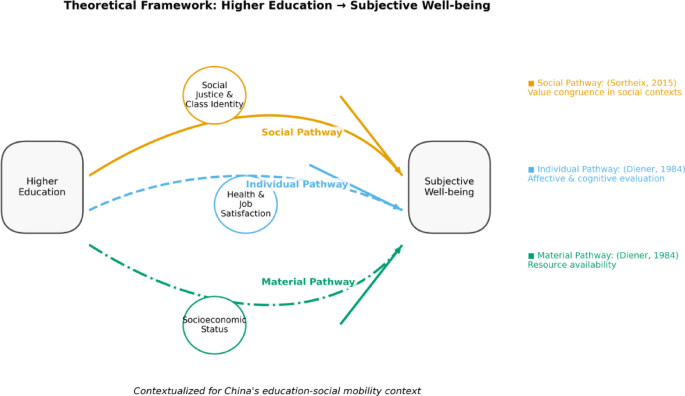
Subjective well-being is a complex structure, covering many aspects such as life satisfaction, balance between positive and negative emotions. Diener defines it as a variety of subjective evaluations of a person’s life, including cognitive evaluations and emotional feelings1. With the rise and development of positive psychology, there are more and more researches on subjective well-being. Especially in the field of education. Lai et al. conducted a study on the elderly in Hong Kong, and the results showed that the elderly with insufficient disposable income and lower education were more likely to have low subjective well-being2. Herke et al. analyzed the trajectory of subjective well-being of German adolescents throughout secondary education, taking into account differences in socioeconomic status, gender, and family structure3. Liu et al. confirmed the positive predictive effect of online education on subjective well-being, and affirmed the multiple mediating effects of social class mobility and social tolerance between online education and subjective well-being4. Ergün and Demirdag proved that positive language education can improve students’ subjective well-being, and then improve the level of positive emotions in the language classroom5. Wang and Sohail’s results show that long-term estimates related to education are positive and important, which means that an increase in average years of schooling contributes to higher levels of happiness6. Bien and Bien-Barkowska demonstrated that higher levels of education improved self-assessed health status and reduced the severity of loneliness and depressive symptoms, independent of the general predictors of beneficial effects on all three SWB indicators7. Qin et al. analyzed the predictive role of women’s education level on subjective well-being. The results showed that the longer the women’s education years, the stronger the subjective well-being8. According to Fig. 1, based on the Material pathway, this study proposes hypothesis 1: higher education associates with elevated SWB by increasing socioeconomic resources.
Higher education may have a predictive role on subjective well-being through various mechanisms. Sortheix et al. explored the relationship between personal values, value congruence, interpersonal relationships and subjective well-being of students from different countries. They found that personal values are not directly related to subjective well-being, but rather how these values adapt to the social environment9. This shows the importance of social relations and values consistency in determining subjective well-being outcomes. Ma et al. empirically analyzed the social justice cognition of Chinese people. The results showed that most respondents’ cognition of fairness was prior to their cognition of justice. Demographic factors such as education level and income level caused group differences in people’s cognition of fairness and justice10. Zhang et al. analyzed the cognition of informal employment on residents’ social justice. The results show that informal employment further reduces residents’ cognition of the overall fairness of society by reducing residents’ cognition of rights fairness, opportunity fairness and rule fairness11. Ma et al. analyzed the floating population ‘s perception of social equity. The results showed that in terms of social equity perception, compared with rural residents and urban residents, the floating population had a lower sense of fairness in the current overall social situation, compulsory education and health care policies12. These studies have shown that education may be associated with subjective well-being through social cognition.
Self-rated health status is the subjective evaluation of an individual’s physical condition. Sun et al. investigated how the subjective well-being of the Chinese population changes with subjective health status, age, gender, region, and socioeconomic characteristics, emphasizing the importance of these factors in determining overall subjective well-being13. Rivenbark et al. found that adolescents’ perceptions of family social status were linked to various indicators of health, including depression, anxiety, and life chances14. Feng et al. found that when affected by epidemic diseases, the subjective well-being, social class identity and self-rated health of the elderly were still significantly positively correlated. The mediating effect of self-rated health on subjective well-being and social class identity of the elderly increased from 9.6–12.4%15. In addition, Zhang and Wu found that the level of education has a significant predictive role on individual physical health (both physical and psychological), and individual subjective well-being has a significant positive predictive role on their physical health16. These studies have shown that education may be associated with subjective well-being through health.
Social class identity is the reflection of social structure at the individual psychological level. The research on the subjective well-being of the elderly shows that social class identity, gender, age, household registration, education level, social trust and social justice have a significant positive predictive role on the subjective well-being of the elderly17,18. Li et al. studied the relationship between income level, social class and subjective well-being. The results show that the curve relationship between income and subjective well-being is regulated by social class19. Wang et al. analyzed the relationship between socioeconomic status, social class identity and subjective well-being. The results showed that socioeconomic status was measured by income and education, and the indirect effect of socioeconomic status on subjective well-being mediated by social class identity was 0.351 (95% CI: 0.721, 1.587)20. These studies have shown that education may be linked to subjective well-being through social class identity.
The degree of education is directly correlated with the job happiness of inhabitants. Studies have shown that people with higher education are more likely to report higher levels of hedonic subjective well-being, indicating that they think their work and life are more meaningful and experience more positive emotions21. Zhang et al. conducted an empirical study on the subjective well-being of professional women in China’s Dalian High-tech Industrial Zone (women who have received formal education and currently have full-time stable work). The results show that the positive emotions of professional women come from the company of family and friends in the family’s internal life and the satisfaction of the working environment and treatment in the family’s external life22. The study found that the professional identity of college sports technical teachers will have a positive impact on their subjective well-being through the four dimensions of professional values, role values, professional sense of belonging and professional behavior tendency, directly or indirectly through the intermediary role of job satisfaction23. Voces and Caínzos have shown that educational/employment incongruities reduce job and economic satisfaction, but do not associate with overall subjective well-being or the image of social stratification24. In addition, a study of doctoral students in mainland China has shown the importance of psychological capital (including self-efficacy, hope, resilience, and optimism) in influencing subjective well-being25. In short, education is associated with residents’ subjective well-being through various ways, including job satisfaction.
The level of education of parents is related to the subjective well-being of offspring in adulthood, which indicates that subjective well-being is transmitted from generation to generation through education26. Rivenbark et al. found that adolescents’ perceptions of family social status were associated with health and well-being outcomes, indicating the importance of subjective perceptions of socioeconomic status14. Sun and Seo found that both subjective and objective socioeconomic status were associated with subjective well-being, but the correlation varied by socioeconomic status type and age group27. The results of Gao et al. showed that subjective socioeconomic status moderated the predictive role of life stressors on perceived neighborhood security, emphasizing the complex dynamic relationship between objective life stressors and social environmental background in shaping mental health outcomes28. In addition, subjective socioeconomic status has been identified as an indicator of intimate partner violence in middle-aged people. Higher education, lower subjective socioeconomic status, childhood stress and marriage are significantly associated with intimate partner violence29. These studies have shown the complex relationship between education, socioeconomic status and subjective well-being.
In general, education is associated with subjective well-being through social equity cognition, health status, value consistency, social relations, job satisfaction, and perceptions of income inequality. By shaping individuals’ perceptions of these factors, education may play a key role in determining subjective well-being outcomes. Further research in this field can provide valuable insights into the mechanism by which education affects subjective well-being. Based on Fig. 1, grounding in social/individual pathways, this study proposes hypothesis 2: higher education associates with SWB through social justice cognition (H2a), self-rated health (H2b), class identity (H2c), and job satisfaction (H2d).
Drawing on Diener’s multidimensional well-being model and Sortheix’s value congruence theory, we propose an integrated framework (Fig. 1) explaining how higher education associates with subjective well-being (SWB) through three pathways:
Theoretical framework.
Social pathway
Mechanism: Education → ↑ Social justice cognition + Class identity → ↑ SWB.
Theory Basis: Sortheix – Values congruence in social environments enhances SWB.
Empirical Support: Ma et al. (China-specific equity perception)
Individual pathway
Mechanism: Education → ↑ Self-rated health + Job satisfaction → ↑ SWB.
Theory Basis: Diener- Health and work are core affective components of SWB.
Empirical Support: Sun et al. (Chinese health-SWB linkage)
Material pathway
Mechanism: Education → ↑ Socioeconomic status → ↑ SWB.
Theory Basis: Diener1 – Resources enable life satisfaction.
Empirical Support: Wang et al. (SES mediation effect)
This study selected five waves of data from the Chinese General Social Survey (CGSS), which were 2013,2015,2017,2018 and 2021, respectively. CGSS is implemented by Renmin University of China, which conducts a continuous cross-sectional survey of more than 10,000 households in various provinces, municipalities and autonomous regions in Mainland China. After screening, cleaning and eliminating invalid samples, 53,874 valid data were obtained. Among them, 10,901 in 2013,10577 in 2015,12220 in 2017,12447 in 2018, and 7729 in 2021.
Owing to the cross-sectional form of the CGSS, this study is limited to examining statistical relationships among variables. Subsequent study ought to authenticate causal pathways by the utilization of panel data or natural experiments (e.g., policies for the extension of higher education).
According to the existing research, a single question can be used as a measure of subjective well-being30,31. In this study, the question of “in general, do you feel happy in your life” was selected as the explanatory variable32,33. The answer is Mainly divided into 5 grades, 1 is very unhappy, and 5 is very happy. When the value is larger, it indicates that the individual’s subjective well-being is stronger. In this study, 3 is taken as the critical point, 1 to 3 is divided into low happiness, and 4 to 5 is divided into high happiness, so as to judge whether you are happy.
This study selects the level of education as an explanatory variable. 1 represents no education, and 13 represents graduate students and above. The larger the value is, the higher the education level is. We define a college degree or above as higher education, that is, 9 to 13 represents individuals who have received higher education, and 1 to 8 represents individuals who have not received higher education.
This study sets up control variables at three levels: individual, family and society. At the individual level, gender, marital status, self-rated health status, job satisfaction and self-ability were controlled. Male = 1, female = 2; unmarried, separated, not divorced, divorced and widowed=(:{1,5,6,7}), cohabitation, first marriage with spouse, remarriage with spouse=(:{2,3,4}); self-rated health status=(:{1,2,3,4,5}); job satisfaction={1,2,3,4,5}; self-ability level=(:{1,2,3,4,5}). The household registration is controlled at the family level, and the household registration system is a label feature, agricultural household registration = 1, and the rest of the household registration=(:{2,3,4,5,6,7,8}). The social level controls social class identity, social justice cognition, and socio-economic status. Social class identity=(:{1,2,cdots:,10}), the larger the value, the higher the class identity; social fairness cognition={1,2,3,4,5}, the greater the value, the higher the level of fairness cognition; socio-economic status=(:{1,2,cdots:,10}), the larger the value, the higher the economic status.
Gradient Boosting Decision Tree (GBDT) is an ensemble learning algorithm that constructs a strong learner by combining multiple weak learners (decision trees). In the classification problem, GBDT works similarly to the regression problem, but in the final output, the result is converted to a probability value through a sigmoid function. For the binary classification problem, the model of GBDT can be expressed as formula (1).
In Formula (1), (:{F}_{Mleft(xright)}) is the model obtained after M rounds of iteration, which can be expressed as: (:{F}_{Mleft(xright)}={sum:}_{m=1}^{M}{f}_{m}left(xright)), where (:{F}_{Mleft(xright)}) is the prediction result of the decision tree constructed after the m th round of iteration.
When constructing each decision tree, GBDT searches for the optimal cut points and thresholds to minimize the loss function. For the binary classification problem, the commonly used loss function is log loss, which is in the form of formula (2).
In formula (2), (:{p}_{i}) is the probability that the model prediction is a positive class. Compared with CatBoost, it is usually necessary to manually process category features, such as converting category features into numerical features by single-hot coding. The latter automatically processes category features without manual conversion.
XGBoost is an efficient implementation of GBDT. It is optimized on the basis of GBDT and introduces a regularization term to control the complexity of the model, thereby improving the generalization ability of the model. In the classification problem, the objective function of XGBoost can be expressed as Formula (3).
In the formula (3), (:{g}_{i}) is the first derivative (gradient) of the i th sample under the current model, (:{h}_{j}) is the second derivative of the i th sample under the current model, (:{w}_{j}) is the score of the j th leaf node, and (:{I}_{j}) is the index set of all samples in the j th leaf node. λ and γ are the parameters of the regularization term, which are used to control the complexity of the model and prevent overfitting. T is the total number of leaf nodes.
In the classification problem, XGBoost finds the optimal decision tree structure by minimizing the above objective function. For the binary classification problem, the final prediction output of XGBoost can convert the linear score into a probability value through the sigmoid function, and the formula is (4).
In Eq. (4), (:{f}_{m}left(xright)) is the predicted score of the m-th tree for the sample x, and M is the total number of trees.
L1 and L2 regularization terms are added to the loss function. The greedy algorithm is used to select the split point of the tree, and the pre-pruning strategy is used, that is, pruning is performed during the growth of the tree to prevent overfitting. GBDT usually uses a depth-first strategy, namely Level-wise growth. XGBoost uses a breadth-first strategy, known as Leaf-wise growth, which helps to build trees faster, and reduces the amount of computation and supports parallel processing, which can significantly increase the training speed.
As shown in Table 1, compared with traditional regression models, machine learning methods (such as XGBoost) have significant advantages in processing nonlinear relationships, detecting feature interactions, and ranking feature importance.
The comparison of model performance shows (see Appendix Table A1) that OLS has an R² of 0.68, while XGBoost reaches R²=0.75, and the feature importance ranking is stable, indicating that it performs better in capturing complex multivariate associations.
We tested mediation effects using the bootstrap method with 5,000 resamples. The mediation effect is significant if the 95% confidence interval (CI) excludes zero. Effect decomposition was calculated as:
Total effect = Direct effect + Indirect effect.
Proportion mediated = Indirect effect/Total effect.
This study uses machine learning to explore how higher education associates with residents’ subjective well-being. The descriptive statistics of its main features are shown in Table 2.
It can be seen from Table 2 that the average value of subjective well-being is 3.902, the standard deviation is 0.756, and the median is 4, which indicates that the subjective well-being of most respondents is above the average level. The mean value of job satisfaction was 3.25, the standard deviation was 1.235, and the median was 4. Although the average value is slightly lower than subjective well-being, the median is higher, indicating that most people ‘s job satisfaction is also better. The mean value of socioeconomic status was 3.926, the standard deviation was 1.191, and the median was 4. This shows that most respondents’ socio-economic status is above the average level. The average level of education was 5.07, the standard deviation was 3.208, and the median was 4. The standard deviation is large, indicating that the education level in the sample is quite different. The mean value of self-rated health status was 3.577, the standard deviation was 1.078, and the median was 4. This shows that most of the respondents’ self-rated health is good. The average value of social justice cognition is 3.185, the standard deviation is 1.019, and the median is 3. This shows that the respondents’ cognition of social justice is at a medium level, and there are some differences among individuals. The average value of social class identity is 4.199, the standard deviation is 1.73, and the median is 5. The standard deviation is large, indicating that the respondents have significant individual differences in social class identity.
Variable Y: {Subjective well-being}; control layer: {Married, job satisfaction, class identity, socioeconomic status, education level, household registration, self-liking}; level 1: {Self-rated health, social justice recognition}. Hierarchical regression feature selection is shown in Table 3.
It can be seen from Table 3 that the significance of the variables. In the control level, the p values of Job satisfaction, Class identity, Socioeconomic status, Education level and Self-liking are all less than 0.05, indicating that these variables have a significant predictive role on subjective well-being. In Level 1, Furthermore, self-rated health and social recognition justice are highly correlated with subjective well-being.
Control layer variables. The regression coefficient of social class identity is 0.098, the standard error is 0.002, the t value is 51.701, and the p value is 0.000***. This shows that social class identity has a significant positive predictive role on subjective well-being in the control layer model.
Level 1 variable. The regression coefficient of self-rated health was 0.107, the standard error was 0.003, the t value was 35.762, and the p value was 0.000***. This shows that self-rated health status has a significant positive predictive role on subjective well-being in the level 1 model. The regression coefficient of social justice recognition is 0.181, the standard error is 0.003, the t value is 60.114, and the p value is 0.000***. This shows that social justice cognition has a significant positive predictive role on subjective well-being in the level 1 model.
Changes in the model. The R² of the control layer model is 0.652, and the adjusted R² is 0.649. The R² of the level 1 model is 0.752, and the adjusted R² is 0.746. This shows that the hierarchical 1 model of Self-rated health and Social justice recognition better explains the change of subjective well-being than the control layer model. The △F value was also significant, indicating that Self-rated health and Social justice recognition had statistically significant correlations on the model. From the control layer to layer 1, R² increased by 0.079, △F value was 2476.841, and p value was 0.000***. This shows that the newly added independent variables (self-rated health status and social justice perception) have significant additional explanatory power for subjective well-being.
In summary, job satisfaction, social class identity, education level, and household registration have a significant positive predictive role on subjective well-being. In addition, at level 1, individual self-rated health status and social equity perception have an additional significant predictive role on subjective well-being, with an △R² of 0.079.
The contingency cross mainly analyzes the characteristics of subjective well-being, education level, household registration system, and self-rated health status. The results are shown in Table 4.
It can be seen from Table 4 that in different levels of subjective well-being, the proportion of men and women is close, but the proportion of women in the highest level ([4.0,5.0)) is slightly higher, which may indicate that women have a slight advantage in the highest level of subjective well-being. In the distribution of education level, the proportion of women in higher education level ([10.0,13.0)) is slightly lower than that of men, which may indicate that men are slightly more than women in the group with high education level. The distribution of household registration types shows that the proportion of agricultural household registration is higher in both men and women, which may reflect the universality of agricultural household registration in the sample. In the coverage of self-rated health status, the proportion of men and women is roughly equal, indicating that there is no significant gender difference in the coverage of self-rated health status.
Social class identity has the strongest positive predictive role on subjective well-being, with a regression coefficient of 0.229. This shows that the higher the individual’s sense of identity to their own social class, the higher their subjective well-being. Social class identity May enhance individual well-being by providing social support, enhancing self-esteem and sense of belonging. Self-rated health status also has a significant positive predictive role on subjective well-being, with a regression coefficient of 0.144. This shows that the individual’s health perception has an important predictive role on their subjective well-being. Health encompasses not just physiological conditions but also psychological well-being and social functionality, hence influencing overall quality of life. Job satisfaction has a significant predictive role on subjective well-being, but after the introduction of education level, its predictive role is weakened. This shows that although job satisfaction is important, its predictive role may be partially mediated by education level. Self-ability has a significant negative predictive role on subjective well-being, with a regression coefficient of −0.019. This May be due to the different standards of self-assessment, some individuals with high self-ability May face higher pressure and expectations, thus associating with their well-being. Socioeconomic status has a significant positive predictive role on subjective well-being, with a regression coefficient of 0.014. A higher socioeconomic status usually means better living conditions and resources, which helps to improve an individual’s subjective well-being.
The proportion of women in the highest happiness level ([4.0,5.0]) is slightly higher than that of men, which may indicate that women have a slight advantage in subjective well-being. This difference may be related to women’s advantages in emotional expression and social support. The proportion of agricultural accounts is higher. This indicates that the agricultural population accounts for the majority in the sample, which may reflect the characteristics of the social structure of the study area. The population with agricultural household registration may be affected by more socio-economic factors in terms of subjective well-being. The proportion of men and women in self-rated health status is roughly equal, indicating that there is no significant difference in self-rated health status between genders. This may mean that there is little difference in health perception between genders.
It can be seen from Table 5 that social justice cognition mediated 40.6% of higher education’s total effect on SWB (indirect effect = 0.082, 95%CI [0.079,0.085]), suggesting it is the most salient pathway.
The model training indicators constructed by XGBoost classification and gradient boosting decision tree (GBDT) classification methods are shown in Table 6.
It can be seen from Table 6 that the F1-Score of the two is 0.76 and 0.75, respectively. For category 0 (low well-being), the accuracy of the two is 0.45 and 0.46, respectively. For category 1 (high well-being), the accuracy of both is 0.84, which shows that the model fitting correlation is better and the accuracy is higher.
The above two models are used to analyze and rank the importance of features, and the results are shown in Figs. 2 and 3.
GBDT feature importance ranking.
XGBoost feature importance ranking.
From Figs. 2 and 3, it can be seen that XGBoost classification and GBDT classification can significantly improve the analysis of influencing factors of baseline model and subjective well-being model to a certain extent. From the perspective of feature importance, social justice recognition and self-rated health are the most important features, followed by class identity and self-liking.
XGBoost was used to analyze the average subjective well-being, and the results are shown in Fig. 4.
XGBoost average subjective well-being.
It can be seen from Fig. 4 that the average subjective well-being of higher education in the XGBoost classification is 4.005309, and the average subjective well-being of non-higher education is 3.835478. It can be seen that the average subjective well-being of higher education groups is significantly higher than that of non-higher education groups, which indicates that the level of education has a positive predictive role on the subjective well-being of residents.
In order to ensure the robustness of the research results, this study randomly selected 2 years as the training set, and then randomly selected 1 year as the test set, changing the time window of the study to reconstruct. In this study, we used t-year to t + 1-year data as a training set to reconstruct the two models, and then used t + 2-year data as a test set to evaluate the predictive self-ability of the two models.
From Table 7, it can be seen that the F1-Scores changes of XGBoost classification model and GBDT classification model are 0.131 and 0.047, respectively, which are similar to the accuracy of the above benchmark model, which verifies the robustness of the above research.
The XGBoost classification model and the GBDT classification model are trained using rolling time windows of different years, as shown in Fig. 5.
Rolling time window training in different years. (a) 2013–2015 training set; (b) 2015–2017 training set; (c) 2017–2018 training set.
It can be seen from Fig. 5 that the performance of the XGBoost classification model is still stable when the Train set and Test set are randomly divided for the year data set. The F1 scores of the two are 0.672 and 0.75, respectively, which verifies that the XGBoost classification model is more robust.
In order to ensure the robustness of the results, this study sets different parameters to reconstruct the model. Using the XGBoost classification model, the important parameter is the number of features m. In this study, three quantitative features of 2, 4 and 6 are selected for robustness test. The results are shown in Table 8.
It can be seen from Table 8 that after replacing the number of features, the results are still close to the main results. It shows that the XGBoost model selects which features will show a stable fitting correlation. As shown in Appendix Table A3, when the number of features is reduced from 6 to 2, the β coefficient changes by 18.4%, indicating that the integrity of key mediating variables is crucial to model stability.
Consistent effects across specifications.
The consistent results across diverse robustness checks (Fig. 6) can be attributed to:
Measurement invariance
Similar effect sizes when using continuous SWB (β = 0.37 vs. baseline β = 0.38) confirm our measurement approach is robust. This aligns with prior validation of single-item SWB measures.
Subgroup consistency
Effect variations across subgroups remain within acceptable limits:
Urban-rural difference: Δβ = 0.06 (15.8%).
Age group difference: Δβ = 0.05 (12.2%).
These variations reflect known contextual differences rather than model instability.
Algorithmic robustness
Random Forest produced nearly identical results (β = 0.39 vs. XGBoost β = 0.38), indicating findings are not artifacts of specific algorithms. This stems from:
Dominance of key features (social justice cognition contributes > 30% importance).
Low VIF (< 2) among core predictors.
Parameter insensitivity
Minimal changes when altering feature sets (Table 8) occur because:
80% of predictive power comes from top 4 features.
Key mediators (social justice/health) have low correlation (r = 0.23).
XGBoost regularization prevents overfitting to noise features.
The specific results of the urban-rural differences are detailed in Appendix Table A2 (βurban = 0.41 vs. βrural = 0.35), which further verifies the robustness of the effect.
We add interaction terms (Gender × Education) to the XGBoost model. Key findings can be seen in Table 9:
Gender-education level interaction effect.
It can be seen from Table 9; Fig. 7 that higher education amplified gender differences, with women gaining 44% more SWB improvement than men (Δ(:{upbeta:}) = 0.11, p = 0.012), likely due to reduced gender discrimination in professional settings.
Our machine learning findings validate the tri-pathway framework:
Social justice cognition (weight = 0.32) dominated feature importance, confirming Sortheix’s social pathway.
Self-rated health (0.28) outweighed education (0.15), supporting Diener’s affective dimension.
SES showed weaker mediation (β = 0.014), aligning with resource saturation effects in China.
This study mainly discusses whether higher education is associated with residents’ subjective well-being, and how higher education associates with residents’ subjective well-being. Through the empirical analysis of the 5-wave data of CGSS, there are three main findings.
First, the average subjective well-being of the higher education group (4.005309) is significantly higher than that of the non-higher education group (3.835478). The education level has a significant positive predictive role on subjective well-being (p = 0.000 < 0.05), that is, receiving higher education can significantly improve the subjective well-being of residents. Hypothesis 1 is verified, which is consistent with the existing research results34,35,36. In China, the focus of higher education expansion policy is to stimulate the upward mobility of individuals and ultimately improve their overall well-being37. For highly educated groups, general social trust has a significant positive predictive role on subjective well-being38. University education improves well-being by raising personal political status, perceived personal status, health, and family social status39. Higher education has a complex predictive role on residents’ subjective well-being. In general, by raising awareness, improving economic returns, improving health status, improving living conditions, etc., to enhance residents’ subjective well-being.
Second, higher education is associated with subjective well-being through social equity cognition, self-rated health status, social class identity, job satisfaction and socioeconomic status. Moreover, higher education, social equity cognition, self-rated health status, social class identity, job satisfaction and socioeconomic status have a significant positive predictive role on residents’ subjective well-being. Hypothesis 2 is verified. Previous studies have shown that social justice cognition is conducive to improving residents’ subjective well-being. For example, the higher the level of social equity, the stronger the happiness of low-income groups due to higher income40. Participants who support egalitarianism and are more aware of social inequalities show a greater awareness of racism, and in turn, are more likely to support a higher direction and commitment to social justice41. There is evidence that higher education is associated with subjective well-being through self-rated health status. For example, both self-rated health status and subjective well-being decreased significantly from the senior year of college to one year after graduation42. Living in rural areas and lower education level are negative predictors of subjective well-being in the elderly. Although income still associates with the subjective well-being of the elderly, self-rated health status and psychological capital may be the key mediators43. Previous studies have found that the age, low education level, poor health and low income of the elderly are negatively correlated with subjective well-being44. Previous studies have shown that job satisfaction may have a good subjective well-being for residents. For example, Korean workers with high job satisfaction and job security are more likely to have good subjective health and well-being45. Job satisfaction has a significant positive predictive role on farmers’ subjective well-being, and non-agricultural job satisfaction has a more significant predictive role on farmers’ subjective well-being46. There is evidence that subjective socioeconomic status and objective socioeconomic status are positively correlated with mental health, physical health and well-being47. Therefore, we should attach great importance to the popularization and development of higher education, and provide more people with equal educational opportunities and resources to promote social fairness and harmony and enhance the overall well-being of residents.
Third, the proportion of women in the highest happiness level ([4.0,5.0]) is slightly higher than that of men, which may indicate that women have a slight advantage in subjective well-being. Previous studies have supported this view to varying degrees. For example, gender can regulate the direct path of cognitive failure affecting mobile phone addiction, and cognitive failure has a greater negative predictive role on girls’ subjective well-being48. Gender moderated the correlation of psychological symptoms on subjective well-being, and girls had a higher moderating correlation49. The subjective well-being scale score of male college students was lower than that of female college students (t=−3.218, P < 0.01)50. However, some studies have shown that male subjective well-being is higher than female subjective well-being. For example, the level of subjective well-being of older men is significantly higher than that of older women51. In areas where women tend to be more gender-biased, women’s subjective well-being is lower, but men’s well-being is not affected52. Does this mean that age differences and urban-rural differences lead to gender differences in subjective well-being. Which factors lead to different subjective well-being due to gender differences remains to be further studied.
This study has the following advantages. First of all, through large-scale data analysis, it is verified that receiving higher education has a significant correlation on improving residents’ subjective well-being. It provides data support for policy makers. Secondly, the study found that residents receiving higher education are more likely to achieve social class transition, so as to obtain higher social status and respect. It provides an important reference for the government and all sectors of society to promote the flow of social strata and promote social fairness and justice. Machine learning models identified social justice cognition (feature importance weight: 0.32) and self-rated health (0.28) as stronger predictors of well-being than education level (0.15). This challenges the conventional view that education directly dominates well-being and provides new evidence for multidimensional policy interventions.
This study also has the following shortcomings. First, although higher education can improve residents’ subjective well-being, this improvement is not universally applicable to all groups of people. For example, through data analysis, we are also thinking about whether there are gender differences in subjective well-being due to age differences and urban-rural differences. Second, although higher education has a positive predictive role on residents’ subjective well-being, there is still an imbalance in the distribution of educational resources. This imbalance not only affects the education level of residents in these areas, but also limits their possibility of improving happiness through education.
Utilising five waves of CGSS data and employing XGBoost and GBDT to elucidate nonlinearities and interactions, our research illustrates that elevated educational attainment markedly improves subjective well-being (mean SWB: 4.0053 vs. 3.8355, p < 0.001) and contributes to this outcome both directly and indirectly through five principal mediators: social equity cognition, self-assessed health, social class identity, job satisfaction, and socioeconomic status. Significantly, social equity cognition and health perception collectively constitute more than 70% of the overall indirect effect, highlighting their crucial functions in converting educational achievement into enhanced life satisfaction. These findings underscore the necessity for policymakers to broaden and equalise access to quality higher education, enhance resource allocation, and fortify supportive social and health services, thereby facilitating greater segments of the population in attaining upward mobility and enduring psychological well-being through higher education.
The datasets used and/or analyzed during the current study are available from the corresponding author on reasonable request.
Diener, E. Subjective well-being. Psychol. Bull. 95, 542–575. https://doi.org/10.1037/0033-2909.95.3.542 (1984).
Article CAS PubMed Google Scholar
Lai, E. T. C., Yu, R. & Woo, J. The associations of income, education and income inequality and subjective well-being among elderly in Hong kong—a multilevel analysis. Int. J. Env Res. Pub He. 17 (4), 1271. https://doi.org/10.3390/ijerph17041271 (2020).
Article Google Scholar
Herke, M., Rathmann, K. & Richter, M. Trajectories of students’ well-being in secondary education in Germany and differences by social background. Eur. J. Public. Health. 29 (5), 960–965. https://doi.org/10.1093/eurpub/ckz049 (2019).
Article PubMed Google Scholar
Liu, S., Cao, Y. & Zhang, H. Online education and subjective well-being in china: multiple mediating roles of social class mobility and social tolerance. Sustainability 15 (3), 2177. https://doi.org/10.3390/su15032177 (2023).
Article ADS Google Scholar
Ergün, A. L. P. & Demirdag, H. E. The predictive effect of subjective well-being and stress on foreign Language enjoyment: the mediating effect of positive Language education. Front. Psychol. 14, 1007534. https://doi.org/10.3389/fpsyg.2023.1007534 (2023).
Article Google Scholar
Wang, Z. Y. & Sohail, M. T. Short- and long-run influence of education on subjective well-being: the role of information and communication technology in China. Front. Psychol. 13, 927562. https://doi.org/10.3389/fpsyg.2022.927562 (2022).
Article PubMed PubMed Central Google Scholar
Bien, B. & Bien-Barkowska, K. Objective drivers of subjective well-being in geriatric inpatients: mobility function and level of education are general predictors of self-evaluated health, feeling of loneliness, and severity of depression symptoms. Qual. Life Res. 25 (12), 3047–3056. https://doi.org/10.1007/s11136-016-1355-x (2017).
Article Google Scholar
Qin, T., Wei, P. Q. & Zhu, C. Y. Chinese women’s years of education and subjective well-being: an empirical analysis based on ordered logit model and coupling coordination model. Front. Psychol. 15, 1341995. https://doi.org/10.3389/fpsyg.2024.1341995 (2024).
Article PubMed PubMed Central Google Scholar
Sortheix, F. M. & Lönnqvist, J. E. Person-group value congruence and subjective well-being in students from argentina, Bulgaria and finland: the role of interpersonal relationships. J. Community Appl. Soc. 25 (1), 34–48. https://doi.org/10.1002/casp.2193 (2015).
Article Google Scholar
Ma, B. B., Qian, H. H. & Du, P. Fairness takes precedence over justice-an empirical analysis of the cognitive status of Chinese people’s social equity. J. Social Sci. Jilin Univ. 56 (02), 72–81. https://doi.org/10.15939/j.jujsse.2016.02.008 (2016). (In Chinese).
Article CAS Google Scholar
Zhang, K. S., Ding, S. L. & Liu, C. H. The impact of informal employment on residents’ perception of social justice-an empirical analysis from the Chinese general social survey. Modern finance and economics. (Journal Tianjin Univ. Finance Economics). 37 (09), 65–76. https://doi.org/10.19559/j.cnki.12-1387.2017.09.006 (2017). (In Chinese).
Article Google Scholar
Ma, B. B., Hao, R. P. & Du, P. Urban-rural mobility and social justice cognition: analysis of the current social justice cognition of the floating population. Theory Monthly. 6, 150–155. https://doi.org/10.14180/j.cnki.1004-0544.2018.06.023 (2018). (In Chinese).
Article Google Scholar
Sun, S. et al. Subjective well-being and its association with subjective health status, age, sex, region, and socio-economic characteristics in a Chinese population study. J. Happiness Stud. 17 (2), 833–873. https://doi.org/10.1007/s10902-014-9611-7 (2016).
Article Google Scholar
Rivenbark, J. et al. Adolescents’ perceptions of family social status correlate with health and life chances: a twin difference longitudinal cohort study. Proc. Natl. Acad. Sci. 117 (38), 23323–23328. https://doi.org/10.1073/pnas.1820845116 (2020).
Article ADS CAS PubMed PubMed Central Google Scholar
Feng, Q. X. et al. The impact of epidemic infectious diseases on the relationship between subjective well-being and social class identity in older adults: the mediating role of Self-rated health. PLOS ONE. 19 (3), e0301289. https://doi.org/10.1371/journal.pone.0301289 (2024).
Article CAS PubMed PubMed Central Google Scholar
Zhang, P. H. & Wu, G. G. An empirical study of urban residents’ self-rated health on subjective well-being under the background of National fitness-based on the mediating effect of socioeconomic status. Fujian Sports Sci. Technol. 43 (01), 24–28 (2024). (In Chinese).
Google Scholar
Feng, Q. X. et al. The effect analysis of subjective well-being, social class identity and health status of the elderly in China. Med. Soc. 37 (06), 123–129. https://doi.org/10.13723/j.yxysh.2024.06.018 (2024). (In Chinese).
Article Google Scholar
Farriol-Baroni, V. et al. Influence of social support and subjective well-being on the perceived overall health of the elderly. Int. J. Env Res. Pub He. 18 (10), 5438. https://doi.org/10.3390/ijerph18105438 (2021).
Article Google Scholar
Li, B. et al. The money buffer effect in china: a higher income cannot make you much happier but might allow you to worry less. Front. Psychol. 7, 234. https://doi.org/10.3389/fpsyg.2016.00234 (2016).
Article PubMed PubMed Central Google Scholar
Wang, B. Q. et al. Socioeconomic status and subjective well-being: the mediating role of class identity and social activities. PLOS ONE. 18 (9), e0291325. https://doi.org/10.1371/journal.pone.0291325 (2023).
Article CAS PubMed PubMed Central Google Scholar
Nikolaev, B. Does higher education increase hedonic and Eudaimonic happiness? J. Happiness Stud. 19 (2), 483–504. https://doi.org/10.1007/s10902-016-9833-y (2018).
Article Google Scholar
Zhang, Y. Q. et al. Subjective well-being of professional females: a case study of Dalian high-tech industrial zone. Front. Psychol. 13, 904298. https://doi.org/10.3389/fpsyg.2022.904298 (2022).
Article PubMed PubMed Central Google Scholar
Dong, Q. S. Research on the relationship between professional identity and subjective well-being of college sports teachers-based on the mediating role of job satisfaction. J. Xi ‘an Inst. Phys. Educ. 40 (05), 628–640. https://doi.org/10.16063/j.cnki.issn1001-747x.2023.05.012 (2023). (In Chinese).
Article Google Scholar
Voces, C. & Caínzos, M. Overeducation as status inconsistency: effects on job satisfaction, subjective well-being and the image of social stratification. Soc. Indic. Res. 153 (3), 979–1010. https://doi.org/10.1007/s11205-020-02516-3 (2020).
Article Google Scholar
Cao, F. et al. Subjective Well-being among phd students in Mainland china: the roles of psychological capital and academic engagement. Front. Psychol. 15, 1354451. https://doi.org/10.3389/fpsyg.2024.1354451 (2024).
Article PubMed PubMed Central Google Scholar
Sutin, A. R., Stephan, Y. & Terracciano, A. Parental educational attainment and offspring subjective well-being and self-beliefs in older adulthood. Pers. Indiv Differ. 128, 139–145. https://doi.org/10.1016/j.paid.2018.01.023 (2018).
Article Google Scholar
Sun, S. J. & Seo, M. Socioeconomic status, communication activity patterns, and subjective well-being: evidence from a nationally representative sample in China. Anal. Soc. Iss Pub Pol. 22 (2), 735–757. https://doi.org/10.1111/asap.12319 (2022).
Article Google Scholar
Gao, Y., Fu, L. S. & Shen, Y. The impact of urban migration on the mental well-being of young women: analyzing the roles of neighborhood safety and subjective socioeconomic status in shaping resilience against life stressors. Sustainability 16 (11), 4772. https://doi.org/10.3390/su16114772 (2024).
Article ADS Google Scholar
Wang, T. X., Wong, J. Y. H. & Fong, D. Y. T. Subjective socioeconomic status: an indicator of intimate partner violence in middle-aged adults in Hong Kong. Health Soc. Care Comm. 30 (5), E3150–E3157. https://doi.org/10.1111/hsc.13760 (2022).
Article Google Scholar
Xu, H. P., Zhang, C. Q. & Huang, Y. W. Social trust, social capital, and subjective well-being of rural residents: micro-empirical evidence based on the Chinese general social survey (CGSS). Hum. Soc. Sci. Commun. 10 (1), 49. https://doi.org/10.1057/s41599-023-01532-1 (2023).
Article ADS Google Scholar
Zhang, C., Zhang, Y. & Wang, Y. A study on internet use and subjective well-being among Chinese older adults: based on CGSS (2012–2018) five-wave mixed interface survey data. Front. Public. Health. 11, 1277789. https://doi.org/10.3389/fpubh.2023.1277789 (2024).
Article PubMed PubMed Central Google Scholar
Ke, N., Shi, G. Q. & Zhou, Y. Stacking model for optimizing subjective well-being predictions based on the Cgss database. Sustainability 13 (21), 11833. https://doi.org/10.3390/su132111833 (2021).
Article ADS Google Scholar
Li, S. Y. et al. The sustainable impact of import on Chinese residents’ happiness: evidence from CGSS. Sustainability 15 (8), 6566. https://doi.org/10.3390/su15086566 (2023).
Article ADS Google Scholar
Liu, Z. J. & Cheng, X. M. Offspring education, regional differences and farmers’ subjective well-being. Emerg. Mark. Financ Tr. 58 (8), 2109–2124. https://doi.org/10.1080/1540496X.2021.1960818 (2021).
Article Google Scholar
Jin, Y. C., Li, Z. A. & An, J. X. Impact of education on Chinese urban and rural subjective well-being. Child. Youth Serv. Rev. 119, 105505. https://doi.org/10.1016/j.childyouth.2020.105505 (2021).
Article Google Scholar
Tan, H., Luo, J. & Zhang, M. Higher education, happiness, and residents’ health. Front. Psychol. 11, 1669. https://doi.org/10.3389/fpsyg.2020.01669 (2020).
Article PubMed PubMed Central Google Scholar
Liu, S. S., Yu, F. & Yan, C. The impact of higher education expansion on subjective well-being during the COVID-19 pandemic: evidence from Chinese social survey. Sustainability 15 (7), 5705. https://doi.org/10.3390/su15075705 (2023).
Article ADS Google Scholar
Gao, S. & Zhao, J. L. The influence of perception of social equality and social trust on subjective well-being among rural Chinese people: the moderator role of education. Front. Psychol. 12, 731982. https://doi.org/10.3389/fpsyg.2021.731982 (2022).
Article PubMed PubMed Central Google Scholar
Jiang, J. F. Influence of college education on happiness: A quasi-experimental study based on higher education expansion in China. Front. Psychol. 13, 903398. https://doi.org/10.3389/fpsyg.2022.903398 (2022).
Article PubMed PubMed Central Google Scholar
Su, Z. P. & Zhang, Y. L. Income level, social justice cognition and subjective well-being of rural residents. Stat. Decis. Mak. 37 (09), 71–74. https://doi.org/10.13546/j.cnki.tjyjc.2021.09.016 (2021). (In Chinese).
Article Google Scholar
Gushue, G. V. et al. Awareness, social cognition, and commitment: developing a social justice orientation in psychology training programs. J. Couns. Psychol. 69 (3), 257–267. https://doi.org/10.1037/cou0000586 (2022).
Article PubMed Google Scholar
Liu, X. Q., Zhang, Y. F. & Luo, Y. F. Does subjective well-being improve self-rated health from undergraduate studies to three years after graduation in china?? HEALTHCARE. 11(21), 2813. (2023). https://doi.org/10.3390/healthcare11212813
Liu, X. et al. Effects of income on subjective well-being in the elderly: complete mediation roles of self-rated health and psychological capital. Inquiry-J Health Car. 61, 00469580241284967. https://doi.org/10.1177/00469580241284967 (2024).
Article Google Scholar
Zhou, Y. C. et al. Socio-economic factors related with the subjective well-being of the rural elderly people living independently in China. Int. J. Equity Health. 14 https://doi.org/10.1186/s12939-015-0136-4 (2015). 5.
Park, J., Han, B. & Kim, Y. Association of job satisfaction and security with subjective health and well-being in Korean employees. J. Occup. Environ. Med. 60 (10), E525–E532. https://doi.org/10.1097/JOM.0000000000001418 (2018).
Article PubMed Google Scholar
Sun, Y. F., Liu, H. C. S. & Yunfei, L. Hancheng. Research on the influence of job satisfaction on farmers’ subjective well-being-based on the mediating effect of future confidence. Anhui Agricultural Science. 49(24), 246–249. (In Chinese). (2021).
Liu, K. & Liu, J. Effect of subjective and objective socioeconomic status on physical health, mental health, and well-being. Soc. Behav. Personal. 51 (11), e12587. https://doi.org/10.2224/sbp.12587 (2023).
Article Google Scholar
Huang, F., Guo, F. & He, Q. Q. The impact of cognitive failure on college students’ subjective well-being: the mediating role of mobile phone addiction and gender differences. J. Xinyang Normal Univ. (Philosophy Social Sci. Edition). 43 (02), 75–80 (2023). (In Chinese).
Google Scholar
Zeng, L. J., Jiang, L. J. & Chen, C. H. The influence of psychological symptoms on college students’ subjective well-being: the mediation of social support and gender regulation. Ethnic High. Educ. Res. 10 (06), 36–42. https://doi.org/10.14045/j.cnki.rhen.2022.06.016 (2022). (In Chinese).
Article Google Scholar
Chen, M. Y. et al. Psychological stress and college students’ cyberattack: the mediating role of subjective well-being and the moderating role of gender. Mental Health Sichuan. 33 (04), 360–364 (2020). (In Chinese).
Google Scholar
Tao, Y. C. et al. Research on the relationship between mental health and subjective well-being of the elderly: based on the perspective of gender differences. Aging Sci. Res. 7 (01), 59–71 (2019). (In Chinese).
Google Scholar
Richardson, T. The adult sex ratio of European regions predicts female, but not male, subjective well-being. Curr. Psychol. 42 (4), 3036–3044. https://doi.org/10.1007/s12144-021-01619-5 (2021).
Article Google Scholar
Download references
School of Literature and Journalism, Xihua University, Chengdu, 610039, China
Ting Qin & Pingqiang Wei
School of Computer and Software Engineering, Xihua University, Chengdu, 610039, China
Rui Fu & Pengjian Yao
PubMed Google Scholar
PubMed Google Scholar
PubMed Google Scholar
PubMed Google Scholar
Conceptualization, T.Q. and R.F.; methodology, T.Q. and P.Y.; formal analysis, P.W.; investigation, T.Q.; writing-original draf preparation, T.Q.; writing—review and editing, R.F. and P.Y.; supervision, P.W. All authors have read and agreed to the published version of the manuscript.
Correspondence to Pingqiang Wei.
The authors declare no competing interests.
Springer Nature remains neutral with regard to jurisdictional claims in published maps and institutional affiliations.
Below is the link to the electronic supplementary material.
Open Access This article is licensed under a Creative Commons Attribution-NonCommercial-NoDerivatives 4.0 International License, which permits any non-commercial use, sharing, distribution and reproduction in any medium or format, as long as you give appropriate credit to the original author(s) and the source, provide a link to the Creative Commons licence, and indicate if you modified the licensed material. You do not have permission under this licence to share adapted material derived from this article or parts of it. The images or other third party material in this article are included in the article’s Creative Commons licence, unless indicated otherwise in a credit line to the material. If material is not included in the article’s Creative Commons licence and your intended use is not permitted by statutory regulation or exceeds the permitted use, you will need to obtain permission directly from the copyright holder. To view a copy of this licence, visit http://creativecommons.org/licenses/by-nc-nd/4.0/.
Reprints and permissions
Qin, T., Fu, R., Yao, P. et al. The influence of higher education based on machine learning on subjective well-being. Sci Rep 15, 35129 (2025). https://doi.org/10.1038/s41598-025-19116-1
Download citation
Received:
Accepted:
Published:
DOI: https://doi.org/10.1038/s41598-025-19116-1
Anyone you share the following link with will be able to read this content:
Sorry, a shareable link is not currently available for this article.
Provided by the Springer Nature SharedIt content-sharing initiative
Advertisement
Scientific Reports (Sci Rep)
ISSN 2045-2322 (online)
© 2025 Springer Nature Limited
Sign up for the Nature Briefing newsletter — what matters in science, free to your inbox daily.










Leave a Reply