

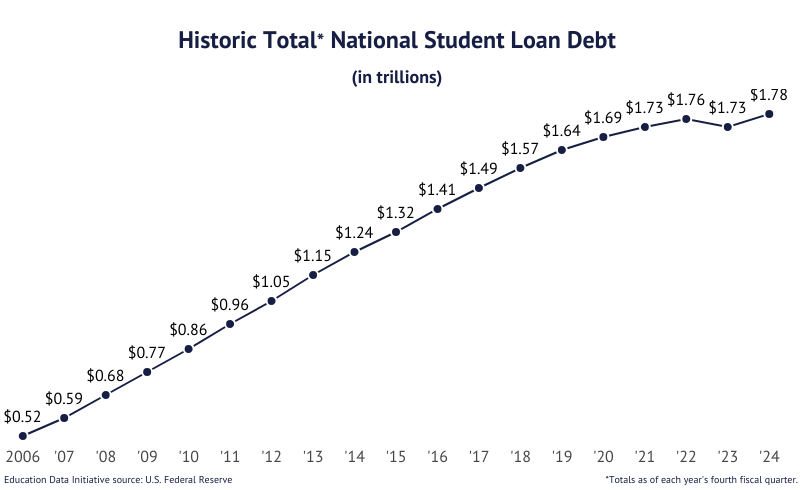
Report Highlights. Student loan debt in the United States totals $1.814 trillion; annual growth resumed in 2024 following a year-over-year (YoY) decline in 2023.
While the first half of 2024 total student loan debt balance continued the annual decline that began in 2023, Q4 saw the highest YoY growth since 2021 Q3.

*Total student loan debt balance as of each year’s fourth fiscal quarter.
Federal student loan interest was 0.0% for most federal loans between March 13, 2020 August 31, 2023.
About half of undergraduates borrow money from the federal government.

Detailed demographic reports include Student Loan Debt by State and by Graduation Year.
For more detailed research, read our report on Student Loan Debt by Gender.
For more detailed research, read our report on Student Loan Debt by Race.
For more detailed research, read our report on Student Loan Debt by Age.
Borrowers with higher levels of education are more likely to have higher student loan debt balances.
The process of student loan forgiveness appears to be muddled by ambiguous processes and errors. Borrowers are often unaware of actually being eligible for student loan forgiveness. Additionally, borrowers who should be eligible have been denied because of negligence or misinformation by their loan servicer.
For more detailed research, view our report on Student Loan Forgiveness Statistics.
Introduced between the second and third financial quarter of 2020, the CARES Act offered student loan debt relief that affected an estimated 35 million borrowers.
In late-2020, media outlets began reporting increased complaints about student loan debt scams. Such reports are not uncommon during desperate times (read: carpetbagger), and as long as there is a student debt crisis, the scams will continue.
Common scams include promises of debt forgiveness, as well as bogus refinancing and consolidation offers that include excessive up-front fees (see our special report on student loan refinancing to find out how to legitimately refinance your student loan debt with no additional fees).
The U.S. Department of Education warns that they will never ask you for your FSA ID password. Your FSA ID is like an electronic signature, which you use to sign legally binding documents electronically. Never give your FSA ID password to anyone or allow anyone to create an FSA ID for you.
If you suspect you have been scammed, complete the following steps in order:
The cohort default rate (CDR) according to the ED is “the percentage of a school’s borrowers who enter repayment on certain FFEL or Direct Loan Program loans during a particular federal fiscal year… and default or meet other specified conditions prior to the end of the second following fiscal year.” Schools with high cohort default rates can be sanctioned, lose eligibility to participate in federal loan programs, or have other consequences. Therefore, it is in an institution’s best interest to have low cohort default rates. Unfortunately, many colleges with high default rates try to lower the rates by abusing the forbearance option for loans. The forbearance option is meant for the benefit of the student, not the institution. In 2017, Navient, one of the largest student loan servicing companies in the US, was found to have collected $4 billion in interest charges incurred by multiple forbearance periods being used by borrowers.
Seventy percent of complaints about the companies servicing student loans are related to mismanagement and deliberate deception. Many students are unaware that they are eligible for income-driven repayment plans on federal loans as required by law and servicers frequently fail to assist them. Instead, borrowers are frequently placed in suspended payment options that rack up interest instead of income-driven repayment plans. Additionally, borrowers frequently enroll in plans their servicers tell them are eligible for Public Service Loan Forgiveness. They make payments for many years only to be denied when they apply because they were not enrolled in a qualifying repayment plan. Service providers also fail to explain that loan consolidation restarts the progress a borrower makes toward loan forgiveness.
As of 2022, Navient is no longer contracted to service federal loans from the U.S. Department of Education.
In 2017, the Consumer Financial Protection Bureau (CFPB) sued Navient (formerly known as Sallie Mae), the largest student loan servicing company in the United States. Under a contract with the US Department of Education, this company services over $300 billion of federal and private student loans. CFPB alleged gross mismanagement, deceiving students and borrowers and depriving them of their legal rights.
We’re a team of researchers who believe important discussions in education deserve to start from a place of fact, not opinion. From hot button topics like student loan debt to high school graduation rates, our mission is to make sure the data surrounding these topics is open & accessible.
© 2025, EducationData.org. All Rights Reserved.










Leave a Reply