

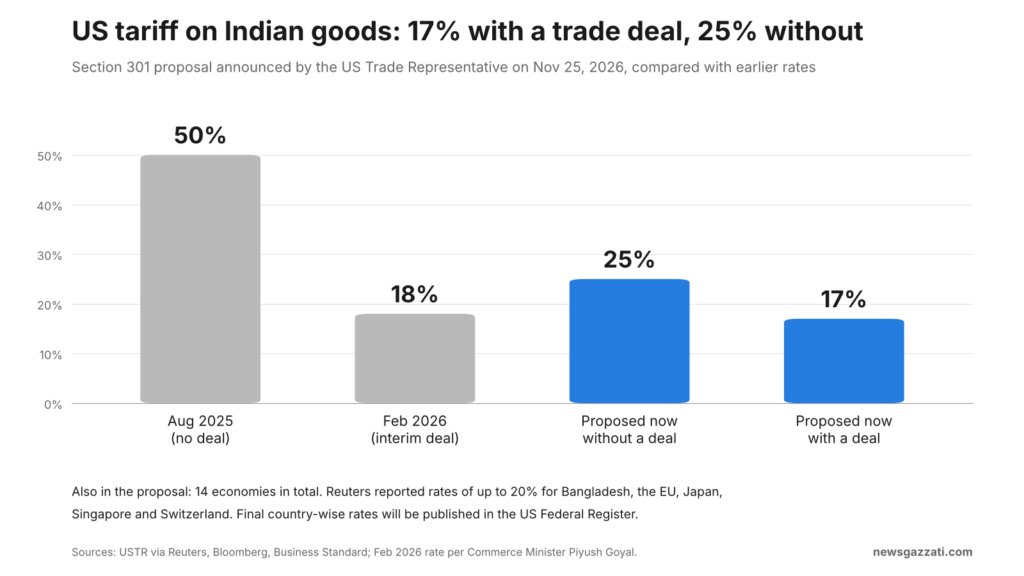
New Delhi / Washington, Nov 26: The United States has put a clear price on India’s delay in signing a trade deal. Under a new proposal from the US Trade Representative, Indian goods would face a 25% tariff, but that rate would drop to 17% if the two countries finally close their long-pending agreement.
Key Highlights
- US proposes a 25% tariff on Indian goods, capped at 17% if a trade deal is signed
- India is among 14 economies named after a Section 301 probe into “excess capacity”
- A 17% rate would be lower than those for Vietnam, Malaysia and Bangladesh
- New Delhi rejects the overcapacity charge; the government calls 17% a negotiating win
- Final country-wise rates will be notified in the US Federal Register
Two rates, one condition
The Office of the US Trade Representative (USTR) on Wednesday proposed fresh tariffs on 14 trading partners, arguing that their industrial policies have created “structural excess capacity” that hurts American manufacturers.
For India, the proposed duty is 25%. US Trade Representative Jamieson Greer said the rate would be capped at 17% if New Delhi and Washington conclude a trade deal.
That lower figure matters. It would place India below several regional rivals such as Vietnam, Malaysia and Bangladesh, giving Indian exporters a relative edge in the US, their largest export market.
Why Washington targeted India
The proposal follows an eight-month investigation under Section 301 of the US Trade Act of 1974. In its findings on India, the USTR flagged:
- industrial expansion policies and subsidies that it says push output beyond demand
- weak labour protections
- financial repression and barriers to market access
- a failure to address global overcapacity, including imports and investment from non-market economies
Besides India, the list covers China, Bangladesh, Cambodia, the European Union, Indonesia, Japan, South Korea, Malaysia, Singapore, Switzerland, Taiwan, Thailand and Vietnam. Mexico and Norway, which were also part of the probe, have been left out for now.
New Delhi pushes back
India has disputed the basis of the investigation from the start. In written submissions earlier this year, the Commerce Ministry said the USTR had offered no real evidence of structural excess capacity in Indian industry and asked for the probe to be closed.
Commerce Ministry official Amitabh Kumar has argued that India’s per-person consumption of products such as steel and textiles remains among the lowest in the world, and that “overcapacity” is not recognised under WTO trade-remedy rules.
Government calls 17% a win
Reacting on Thursday, Minister of State for External Affairs Kirti Vardhan Singh described the lower rate as the result of strong negotiation by India, saying it would put Indian goods ahead of several neighbouring exporters.
Where the trade deal stands
India and the US have been negotiating the first tranche of a bilateral trade agreement since early 2025. In February 2026, Commerce Minister Piyush Goyal said an interim arrangement had cut US tariffs on Indian exports to 18% from 50%. The full agreement is still unsigned, though reports suggest talks are in their final stretch.
What it means for exporters
Until a deal is signed, exporters and investors face uncertainty. A higher duty would raise the landed cost of Indian goods in the US, and American buyers could seek to renegotiate contracts or turn to other suppliers. India’s real gain or loss will also depend on the final rates imposed on rival manufacturing hubs.
What happens next
Country-wise rates are expected to be formally notified in the US Federal Register. A US official indicated that where an exporter faces overlapping rates, only the higher one would apply. For New Delhi, the 8-point gap between 17% and 25% is now a strong reason to close the deal quickly.
Credit: Bloomberg, Business Standard, Business Today, The Week and The Tribune (ANI). Featured image: Igor Omilaev / Unsplash.







Leave a Reply